
Choosing the best flour mill grinder machine depends on what you plan to grind, how much flour you need, and whether you prefer electric speed or hands-on control. The options below include high-speed electric mills for regular baking, a stone mill with adjustable texture control, and manual grinders for smaller or more flexible jobs. Compare their strengths and limitations to find the right fit for your kitchen.
Table of Contents
Quick Comparison
| Product | Type | Standout feature | Best for |
|---|---|---|---|
| NutriMill Impact Compact Electric Grain Mill | Electric impact mill | 1200-watt motor and large-capacity containers | Frequent bread bakers |
| Lehman’s Manual Power Grain Mill | Manual burr mill | Six-cup hopper and option to motorize | Hands-on milling and self-sufficiency |
| Victoria Manual Cast Iron Grain Mill | Manual disc mill | Adjustable grind and broad ingredient range | Coarser grinds and varied kitchen tasks |
| The Kitchen Mill Electric Grain Mill | Electric high-speed mill | Up to 24 cups of flour in under 10 minutes | Large batches in a compact footprint |
| NutriMill Harvest Electric Stone Grain Mill | Electric stone mill | Corundum milling stones and texture control | Shoppers who prefer stone milling |
Our Picks: Best Flour Mill Grinder Machine reviews
NutriMill Impact Compact: Best for Regular Bread Baking

The NutriMill Impact Compact is an electric impact mill designed to turn hard grains such as wheat into fine flour. Its 1200-watt motor and high-speed milling heads make it a strong match for bread bakers who want a dedicated machine rather than a hand-cranked grinder.
The eight-cup hopper and 12-cup flour canister suit larger batches, while the compact design lets the parts nest together for storage. A patented cyclone air-filtration system is designed to maintain airflow during milling. Those capacity and storage details make this a practical choice if you mill often but still need to manage kitchen space.
This mill is more specialized than the manual options: it is built around fast, fine flour production, not a wide range of kitchen grinding jobs. If you only mill occasionally or want a machine that can also handle varied ingredients, compare it with the Victoria. The product information does not specify a noise level, so consider your tolerance for high-speed appliances before choosing.
Pros:
- 1200-watt motor is designed for hard grains such as wheat.
- Impact milling heads are intended to produce fine bread flour.
- Large hopper and flour canister support bigger batches.
- Nesting parts help make storage more compact.
Cons:
- Electric and focused on milling flour, rather than offering the versatility of a manual multi-use grinder.
- The supplied details do not list a noise level or a specific grind adjustment range.
Verdict: Choose the NutriMill Impact Compact if you regularly bake with freshly milled wheat flour and want electric speed with batch-friendly capacity.
Lehman’s Manual Power Mill: Best for Manual Grain Milling

Lehman’s Manual Power Grain Mill uses stainless steel burrs and hand power to grind dry, free-flowing ingredients. Its six-cup hopper gives you room to load a useful amount at once, and the mill is described as producing pastry flour from grains and some small beans.
The 12-inch V-belt flywheel pulley provides momentum for hand grinding, and the mill can also be motorized. Four pre-drilled holes in the base make it possible to bolt the unit down. This is a larger, more permanent-style manual mill than a compact hand-crank model, so plan for a stable work surface and enough room around it.
Its range includes wheat, corn, rye, rice, quinoa, and small beans, but the supplied description does not say it produces the same fine bread flour as the electric impact mills. It makes more sense for shoppers who value manual operation or want the option to motorize later than for someone seeking the quickest route to a large baking batch.
Pros:
- Six-cup hopper supports larger loads for a manual mill.
- Stainless steel burrs have an electrolytically polished surface.
- Can grind several dry grains and small beans.
- Can be motorized, and its base can be bolted down.
Cons:
- Hand grinding takes more effort than using an electric mill.
- Its size and mounting options may not suit a kitchen where the grinder must be stored away after each use.
Verdict: Pick Lehman’s mill if you want a substantial manual grinder with a large hopper and the flexibility to add motor power.
Victoria Cast Iron Mill: Best for Coarse Grinds and Versatility
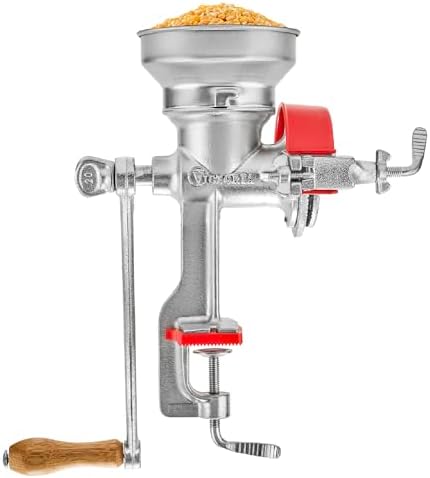
The Victoria is a hand-cranked cast iron mill with adjustable white iron discs. You can change the coarseness by turning the adjustment screw, and its clamp is designed to attach to tables from half an inch to two inches thick. A rubber protector helps protect the surface and reduce slipping during use.
This grinder is notable for its broad stated range of uses, which includes grains, corn, coffee, seeds, spices, nuts, and some other foods. That flexibility can be useful if you want one manual appliance for several kitchen tasks. However, the product description clearly cautions that it cannot grind whole wheat into a fine powder or produce a superfine texture.
That limitation matters if your main goal is fine flour for bread. The electric mills are better suited to that job based on their stated purpose and milling design. The Victoria is a better fit when adjustable coarser grinding and ingredient versatility are more important than a fine, consistent flour texture.
Pros:
- Adjustable screw changes the grind coarseness.
- Cast iron body and hand crank provide a manual design.
- Clamps to many tables within the stated thickness range.
- Designed for a wide range of grains and other ingredients.
Cons:
- Does not make superfine flour or fine whole-wheat powder.
- Manual operation is less convenient for large batches.
Verdict: Choose the Victoria for flexible, hands-on grinding when coarse or medium results are acceptable; skip it if you need fine flour for baking.
The Kitchen Mill: Best for Fast, High-Volume Flour

The Kitchen Mill is an electric high-speed grinder with a 1000-watt motor. Its stated output is up to 24 cups of whole-grain flour in under 10 minutes, making it one of the more batch-focused options here. It is designed to handle wheat, corn, rice, popcorn, beans, legumes, and other listed grains.
The stainless steel micronetic chamber is described as resisting gumming, jamming, and glazing. A clear mill pan lets you monitor the output, and cleaning is described as a matter of brushing or wiping the unit after use. At about eight pounds and roughly 10 by 7.75 by 8.5 inches, it is compact compared with mills built around larger hoppers or mounting bases.
The Kitchen Mill stands out if speed and volume matter more to you than a traditional stone-milling setup. Its eight-year limited warranty on the plastics and motor, along with a lifetime warranty on the grinding mechanism, is another point to consider. As with other high-speed electric mills, you will need access to power, and the product details do not specify a noise level.
Pros:
- Stated capacity of up to 24 cups in under 10 minutes.
- Compact dimensions and a listed weight of about eight pounds.
- Clear pan makes it easier to see the flour output.
- Includes stated warranties for the motor, plastics, and grinding mechanism.
Cons:
- Requires electricity and may be more capacity than occasional bakers need.
- The supplied information does not give a specific texture-adjustment range.
Verdict: The Kitchen Mill is a compelling choice if you want to make large quantities of flour quickly in a relatively compact electric mill.
NutriMill Harvest: Best Stone-Mill Option

The NutriMill Harvest is an electric stone grain mill powered by a 450-watt motor. Its near-diamond-hard Corundum Grainmaster milling stones are designed for milling even hard grains, and its texture control knob lets you adjust the grind. It is described as suitable for non-oily grains and legumes.
The mill includes auto-shutoff thermal protection intended to protect the motor during sustained milling. It is tested and listed by CSA, and the product information says it is designed and assembled in the USA. Compared with the impact mills in this guide, its stone-milling design may appeal to shoppers who specifically want milling stones and control over texture.
One practical caveat is availability: the supplied product data marks this model as unavailable. Check the listing before planning a purchase. If it is not available, the NutriMill Impact Compact and The Kitchen Mill are electric alternatives, though they use different milling designs.
Pros:
- Stone milling with a texture control knob.
- Designed for non-oily grains and legumes, including hard grains.
- Auto-shutoff thermal protection is intended to protect the motor during sustained use.
- Tested and listed by CSA, according to the product information.
Cons:
- The supplied product data marks it as unavailable.
- Its 450-watt motor is lower-powered than the two high-speed electric options in this guide.
Verdict: Consider the NutriMill Harvest if you want an electric stone mill with texture control, but confirm that it is available before making it your first choice.
How to Choose a Flour Mill Grinder Machine
Match the mill to your flour needs
Start with the texture you need. If you want fine flour for bread, focus on mills described for fine flour production, such as the NutriMill Impact Compact or The Kitchen Mill. The Victoria’s product information specifically says it does not make superfine flour or fine whole-wheat powder, so it is not the right pick for that purpose. For adjustable texture with stone milling, consider the NutriMill Harvest if it is available.
Choose electric or manual operation
Electric mills reduce the physical work involved and are suited to faster or larger batches. Manual models do not rely on a motor, but you provide the grinding effort. Lehman’s mill can be motorized, giving it more flexibility, while the Victoria is a hand-crank option. Think about how often you will mill and whether you have a convenient power source before deciding.
Consider batch size and storage
Compare the hopper and flour-container capacities with the amount you usually bake. The NutriMill Impact Compact lists an eight-cup hopper and a 12-cup canister, while Lehman’s mill has a six-cup hopper. The Kitchen Mill emphasizes high output and compact dimensions, and the NutriMill Impact’s parts nest together for storage. Larger capacity can save repeat loading, but it may be unnecessary if you only need small amounts.
Check ingredient compatibility
Do not assume every mill can handle every seed, bean, or grain. The Kitchen Mill lists wheat, corn, rice, popcorn, beans, and legumes. Lehman’s mill is described for free-flowing dry grains and small beans. The Victoria lists a wider range of kitchen ingredients, while the NutriMill Harvest is specified for non-oily grains and legumes. Check the product details for the ingredients you plan to grind.
Think about setup, cleanup, and space
A mill that fits your kitchen routine is more likely to be useful. The Kitchen Mill is listed as compact and can be brushed or wiped after use. The NutriMill Impact’s parts nest for storage. Lehman’s mill has a flywheel and pre-drilled mounting holes, so plan for a stable place to use it. The Victoria clamps to a table within its stated thickness range, which can be helpful if you do not want a permanent installation.
Compare the milling mechanism and warranty details
Impact, burr, disc, and stone mills work differently, so use the stated design and intended output as a guide. The Kitchen Mill lists warranty coverage for its motor, plastics, and grinding mechanism. The NutriMill Harvest lists thermal protection for its motor. Check the current product listing for the full terms and any details that matter to you, since the supplied descriptions do not provide complete warranty information for every model.
Frequently Asked Questions
Which flour mill is best for fine whole-wheat flour?
The NutriMill Impact Compact is specifically described as using high-speed impact milling heads to create fine-textured bread flour. The Kitchen Mill is also designed for high-speed whole-grain flour production. The Victoria is not suitable for superfine whole-wheat powder, according to its product description.
Can a manual grain mill make flour?
Yes. Lehman’s Manual Power Grain Mill is described as grinding dry grains to pastry flour. The Victoria can grind grains too, but its product information warns that it cannot make superfine flour. Match the manual mill to the texture you want.
What is the difference between an impact mill and a stone mill?
The NutriMill Impact Compact uses high-speed impact milling heads, while the NutriMill Harvest uses Corundum Grainmaster milling stones. Both are electric, but they use different milling designs. Choose based on your preference for the stated mechanism, texture control, and availability.
Can these mills grind beans or other ingredients?
Some can, but ingredient limits vary. Lehman’s mill is described for small beans, The Kitchen Mill lists beans and legumes, and the NutriMill Harvest is specified for non-oily grains and legumes. The Victoria lists many additional ingredients. Check the instructions and listing for the exact food you plan to grind.
Which option is best for large batches?
The Kitchen Mill has the largest stated output, at up to 24 cups in under 10 minutes. The NutriMill Impact Compact also has batch-friendly capacity, with an eight-cup hopper and 12-cup flour canister. Compare those details with how much flour you actually use at a time.
Is the NutriMill Harvest currently available?
The supplied product information marks the NutriMill Harvest as unavailable. Availability can change, so check its Amazon listing before deciding. The NutriMill Impact Compact and The Kitchen Mill are other electric options in this selection.
Final Recommendation
For regular bread baking and fine flour, the NutriMill Impact Compact is the strongest all-around match in this group. If you need a high stated output in a compact electric design, consider The Kitchen Mill. Choose Lehman’s Manual Power Mill for a substantial manual setup with a motorizing option, or the Victoria for adjustable, versatile grinding when superfine flour is not required. The NutriMill Harvest is worth considering for stone milling, but check its availability first.
