If you need to keep cats in separate rooms without closing off airflow, a reinforced screen door can be a useful middle ground. The strongest options here use thickened mesh and a zipper, while other designs trade some containment for easier walk-through access. Before you choose, measure the doorway opening—not the whole frame—and consider how firmly the screen can be attached to your particular surface.
Table of Contents
Quick Comparison
| Product | Fits Door Opening Up To | Closure | Best For |
|---|---|---|---|
| QWR Reinforced Cat Screen Door, 32 × 80 in. | 32 × 80 in. | Double zipper | Cat separation and introductions |
| QWR Reinforced Cat Screen Door with Wider Stickers | 32 × 80 in. | Double zipper | Frequent use on a suitable frame |
| QWR Upgraded Pet Screen Door, 30 × 80 in. | 30 × 80 in. | Double zipper | Narrower door openings |
| Dixutzi Reinforced Pet Screen Door | 32 × 80 in. | Screen panel with pull-aside strap | Pass-through access and airflow |
| AUGO Magnetic Screen Door, 38 × 83 in. | 36 × 82 in. | Magnetic center closure | Hands-free passage through a wider opening |
Our Picks: Best Interior Screen Door To Keep Cats Out reviews
1. QWR Reinforced Cat Screen Door: Best Overall for Separating Cats

This QWR screen is made for households that need a visual barrier between cats without shutting off the room completely. Its vinyl-coated steel-wire mesh is thicker than ordinary fiberglass screen material, and the double zipper gives people a way to pass through while keeping the opening closed afterward.
The panel measures 34 × 82 inches and is intended for door openings up to 32 × 80 inches. It attaches with adhesive hook-and-loop strips, and the product description says installation does not require tools. A clean, dry frame should help the adhesive attach properly, but the result depends on the frame surface and how securely the strips hold.
This design is especially useful when you want cats to see and smell one another while keeping them physically separated. Some owners describe using similar QWR screens during gradual cat introductions. Still, a screen is not a rigid gate: a determined cat may push or climb against it, so check the attachment and supervise cats that test the barrier.
Compared with the other QWR options here, this model has a similar opening size and reinforced mesh to the newer 32-inch version. Its listing specifically describes a double zipper inside and outside. Choose it if you want a zippered barrier for a standard-width doorway, but inspect the fit carefully if your cats are strong climbers.
Pros:
- Reinforced vinyl-coated steel-wire mesh
- Double zipper can be opened from either side
- Allows airflow while separating rooms
- Designed for openings up to 32 × 80 inches
Cons:
- Adhesive attachment may not hold equally well on every surface
- Not a rigid barrier for cats that push or climb forcefully
Verdict: Choose this QWR model if you want reinforced mesh and a two-sided zipper for supervised room separation or gradual cat introductions.
2. QWR Reinforced Screen with Wider Stickers: Best for Regular Use

This QWR model is another reinforced, zippered screen for door openings up to 32 × 80 inches. It uses thickened vinyl-coated steel-wire mesh and stronger stitching, with a double-zipper layout described as U-shaped. The screen is sized 34 × 82 inches, so compare those measurements with your clear opening before ordering.
The listing highlights wider adhesive stickers and includes additional tools for securing the screen. It also notes that nails can be used with a wooden frame for a firmer installation. That option may be helpful if you are comfortable making small holes; renters or anyone avoiding frame marks should check what is included and rely on adhesive only if it is suitable for the surface.
Owners describe the screen as useful for maintaining separation while allowing airflow, and some report that the mesh and zippers stand up to normal cat curiosity. Attachment is the key variable: a well-fitted screen on a compatible frame is more dependable than one installed on a surface where the strips have a weak grip. Check the edges and bottom regularly, especially if a cat paws at them.
It is very similar in purpose and size to the first QWR pick. The main distinction in the supplied product information is this model’s emphasis on wider stickers and optional nails for wooden frames. If your priority is a reinforced zippered screen and you have a frame that can support the fastening method, it is a strong alternative.
Pros:
- Thickened mesh with upgraded stitching
- Double zipper for access through the screen
- Wider adhesive strips and extra fastening tools are described
- Nails may provide added support on wooden frames
Cons:
- Adhesive-only installation may be less secure on some frames
- Nail installation may not suit every home
Verdict: This is a good option if you want a reinforced zippered screen and can secure it properly to your frame, particularly if the frame is wood.
3. QWR Upgraded Pet Screen Door: Best for a Narrower Opening
If the standard 32-inch QWR screen is too wide for your doorway, this version is designed for openings up to 30 × 80 inches. The screen itself measures 32 × 82 inches. Like the larger QWR options, it has thickened vinyl-coated steel-wire mesh, upgraded stitching, and a double zipper.
Its smaller fit can make it the more sensible choice for a narrower interior doorway, but measuring still matters. Check the actual opening width and height, and make sure the frame leaves enough suitable surface for the hook-and-loop strips. The listing describes adhesive installation and says nails can be used with a wooden frame for a firmer hold.
The core use is the same as the other QWR screens: a breathable divider that lets cats see and smell each other without sharing the same open doorway. Similar QWR models are described as useful for cat introductions and room separation. That can make this a practical tool for supervised transitions, though the mesh should not be treated as an escape-proof or impact-proof gate.
Compared with the first two picks, the main advantage is its narrower maximum opening size—not a different closure style or a clearly distinct mesh construction. Measure first; do not choose it just because the product panel looks close to your doorway dimensions.
Pros:
- Fits openings up to 30 × 80 inches
- Reinforced mesh and upgraded stitching
- Double zipper allows people to pass through
- Can be installed with adhesive, with nails described for wood frames
Cons:
- Too small for openings wider than its listed limit
- Attachment strength depends on the frame and installation
Verdict: Pick this version when your measured opening is no more than 30 × 80 inches and you want the same basic reinforced, zippered design as the larger QWR screens.
4. Dixutzi Reinforced Pet Screen Door: Best for Easy Pass-Through Access

The Dixutzi screen is made for openings up to 32 × 80 inches and uses thickened vinyl-coated steel wire with upgraded stitching. Its product information describes the mesh as resistant to scratching and biting. A short strap lets you pull the screen aside when you need to pass through often.
Installation uses adhesive hook-and-loop strips, and push pins may also be used to secure the panel. The listing says the screen can be removed without damaging the frame, but results can vary with the frame material and adhesive. Clean the surface before installation and check that the panel sits evenly around the opening.
Unlike the QWR picks, the supplied description does not specify a zipper. That makes this a different style of screen: its pull-aside strap may suit a doorway where people need to move through frequently, but it may be less convenient when you want a clearly stated zippered closure. Consider the exact way it closes and whether it provides enough separation for your cats before choosing it.
This model may also suit homes with dogs, since the listing identifies both cats and dogs as intended pets. However, no screen panel should be assumed to withstand a forceful charge. For a cat that repeatedly pushes at barriers, secure the edges carefully and consider a more rigid option.
Pros:
- Reinforced mesh with upgraded stitching
- Fits openings up to 32 × 80 inches
- Pull-aside strap helps clear the doorway
- Push pins are described as an additional fastening option
Cons:
- The listing does not specify a zipper closure
- Adhesive and push-pin attachment may not suit every frame
Verdict: Consider the Dixutzi if you want reinforced mesh and a pull-aside strap for frequent passage, but choose a zippered model if a defined closure is important for keeping cats apart.
5. AUGO Magnetic Screen Door: Best for Hands-Free Passage
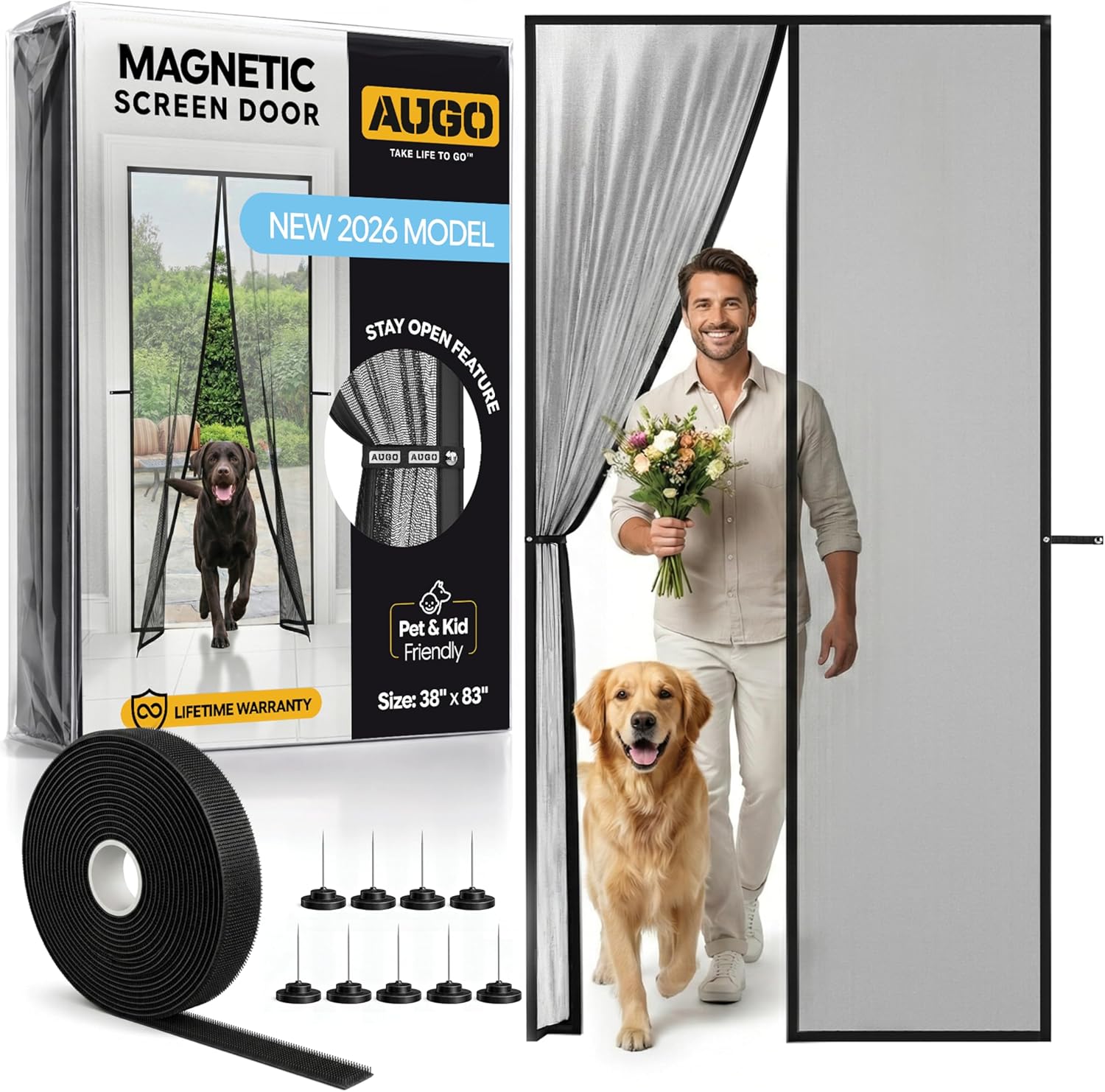
The AUGO is a magnetic mesh screen sized 38 × 83 inches for door openings up to 36 × 82 inches. It attaches to the frame with hook-and-loop tape, with push pins included for added security. Magnets run along the center so the panels close after someone walks through.
This hands-free design is convenient when people are moving in and out often, and the listing describes the polyester mesh as suitable for children and small pets to walk through. That easy passage is also an important difference for cat owners: the screen is not presented as reinforced cat-proof mesh, and a cat may be able to push through the magnetic center.
For that reason, the AUGO is better suited to airflow and insect protection than to keeping a determined cat out of a room. Its larger opening size can be useful where the reinforced QWR and Dixutzi models are too small, but check the fit and consider your cat’s behavior before relying on it as a divider.
Pros:
- Magnetic center closes behind people as they pass
- Designed for openings up to 36 × 82 inches
- Hook-and-loop attachment and push pins are included
- Side snaps hold the screen open when needed
Cons:
- Walk-through magnetic closure may not stop a determined cat
- Polyester mesh is not described as reinforced cat-proof mesh
Verdict: Choose the AUGO for easy passage and airflow, not as your first choice when reliable cat separation is the main goal.
How to Choose an Interior Screen Door to Keep Cats Out
Measure the Clear Doorway Opening
Measure the width and height of the opening itself, not the outside of the trim or frame. The QWR and Dixutzi options are sized for openings up to 32 × 80 inches, while the narrower QWR version is for openings up to 30 × 80 inches. AUGO is designed for a larger opening, up to 36 × 82 inches. Check the product’s screen dimensions and fit limit, and make sure your opening falls within the stated range.
Choose Mesh That Matches Your Cat’s Behavior
Thickened vinyl-coated steel-wire mesh and reinforced stitching are features to look for if your cat paws, scratches, or climbs. The QWR models and Dixutzi screen describe those types of construction. Even reinforced mesh is still a flexible screen, though; it is not the same as a rigid pet gate. If your cat charges barriers or is likely to climb over them, a screen may not provide enough containment on its own.
Pay Attention to the Closure
A zipper gives you more control over whether the opening stays closed after you pass through. The QWR models specify double zippers. The Dixutzi description mentions a pull-aside strap but does not specify a zipper. AUGO uses a magnetic center that closes after someone walks through, but its walk-through design may be easier for a cat to push open. Match the closure to how much containment you need.
Check the Frame and Fastening Method
Hook-and-loop adhesive is quick to install, but its hold depends on the surface. Clean and dry the frame before applying the strips, and avoid assuming that adhesive will hold equally well on painted, textured, or dusty surfaces. Some listings mention push pins or nails as added support, particularly on wood. Consider whether those fastening options work for your home before buying.
Think About How People Will Use the Doorway
If you need to walk through often, a zipper or pull-aside feature can make the screen easier to live with. A magnetic screen is convenient for hands-free passage, but that convenience may be a drawback if your cat can push through it. Think about whether you need a barrier that stays firmly closed or one that people and pets can pass through easily.
Use Screens Carefully During Cat Introductions
A screen can let cats see and smell one another while staying in separate rooms, which may help with gradual introductions. Keep sessions supervised, watch for signs of stress or attempts to force the barrier, and follow a slow introduction plan. The screen is a management aid, not a guarantee that cats cannot make contact or escape.
Frequently Asked Questions
Can a screen door keep every cat out of a room?
No screen door can guarantee that every cat will stay put. Reinforced mesh and a zipper can make a screen more useful for separation, but a determined cat may push, climb, or pull at the panel. Check the installation and supervise cats that test the barrier.
Which option is best for introducing two cats?
The QWR reinforced models are designed for visual separation and have double zippers. Choose the size that fits your doorway, secure it carefully, and supervise introductions. A screen can be part of a gradual process, but it is not a substitute for watching how the cats respond.
How do I know which size to buy?
Measure the clear door opening in both directions. Compare your measurements with the listed maximum opening size, not just the screen’s overall dimensions. For example, the QWR 30-inch model is intended for openings up to 30 × 80 inches, while the 32-inch models fit openings up to 32 × 80 inches.
Will adhesive strips work on any door frame?
Not necessarily. The supplied product information recommends cleaning the frame before applying the adhesive, and owners’ experiences indicate that the hold can vary. Some models also describe pins or nails as added support. Check the frame material and installation instructions, and test the attachment before leaving cats unsupervised.
Is a magnetic screen a good choice for keeping cats out?
It depends on your cat. A magnetic screen is made for easy walk-through access and closes behind people, but a cat may be able to push through the center. For firmer separation, consider a reinforced screen with a zipper instead.
Do these screens stop airflow?
No. Mesh screens are intended to allow air to circulate while dividing the opening. They provide less physical separation than a solid door, so they may not be right for every pet or situation.
Final Recommendation
For most households that want an interior screen to separate cats, the QWR reinforced 32 × 80-inch models offer the most relevant combination of thickened mesh and double-zipper access. The QWR 30-inch version is the better fit for a narrower opening. Consider the Dixutzi if you prefer a pull-aside strap, and choose the AUGO mainly for hands-free passage rather than dependable cat containment. Measure first, check that the fastening method suits your frame, and supervise cats around any flexible screen.