
Choosing the best multi fuel wood stove starts with matching its approved fuels, heating capacity, and installation needs to your space. The options below range from cast-iron cook stoves for cabins to a compact outdoor pellet stove, so they are not interchangeable. Compare their stated features carefully, and check the listing and manufacturer’s instructions before buying: the supplied product data marks all five listings as unavailable.
Table of Contents
Quick Comparison
| Product | Stated fuel | Standout feature | Best fit |
|---|---|---|---|
| LLZJDDPLY Cast Iron Multi-Fuel Stove | Firewood, charcoal, coal, dry branches, straw, and dry leaves | Adjustable cooktop and three-sided viewing glass | Cabins and spaces where cooking and heating are both priorities |
| Generic Cast Iron Multi-Fuel Stove | Firewood, charcoal, coal, dry branches, straw, and dry leaves | Cast-iron body with a pull-out ash box | Buyers seeking a simple cast-iron heating and cooking design |
| WANGJIANPENGPL Steel Wood and Coal Stove | Firewood and coal | Side roasting oven and included chimney components | Spaces needing a dual-fuel stove with more cooking options |
| Joaaea Multi-Fuel Stove | Wood and pellets | Two viewing windows and a modular chimney system | Rooms or cabins where a compact steel stove is a good fit |
| Greenstovehori 5 Max Outdoor Pellet Stove | Pellets; the title also identifies wood burning | Outdoor tent design with an oven | Hot-tent camping and outdoor cooking, not as a general indoor heater |
Our Picks: Best Multi Fuel Wood Stove reviews
1. LLZJDDPLY Cast Iron Stove: A Cooktop-Focused Cabin Option

This heavy cast-iron stove is designed to heat a room while also serving as a cooking surface. Its listing names firewood, charcoal, coal, dry branches, straw, and dry leaves as fuels. The adjustable cooktop ring is intended to accommodate different cookware, giving it more cooking flexibility than a basic space heater.
The listing recommends it for areas up to 70 square meters (753 square feet). Treat that as a starting point, not a guarantee: insulation, ceiling height, layout, and climate all affect how much heat a space needs. Three-sided sealed glass gives you views of the fire, while adjustable air vents let you control airflow. A pull-out ash box and included fire tools are practical touches for regular use.
The main trade-off is its broad fuel list: having several named fuel options does not mean every fuel is suitable in every installation. Confirm the stove’s instructions and local requirements before burning anything. The listing also does not provide dimensions, flue details, or installation clearances in the supplied information. Compared with the steel models here, this one puts more emphasis on a cast-iron body and a versatile cooktop.
Pros:
- Cast-iron construction and a cooktop with an adjustable ring
- Listing names several fuel types
- Three-sided viewing glass and adjustable air vents
- Pull-out ash box and fire tools are included
Cons:
- Dimensions and key installation details are not provided in the supplied data
- The supplied listing data marks this product unavailable
Verdict: Consider this model if you want a cast-iron stove that combines room heating with a flexible cooking top, but verify its availability, fuel instructions, and installation requirements first.
2. Generic Cast Iron Stove: A Straightforward Heating-and-Cooking Design
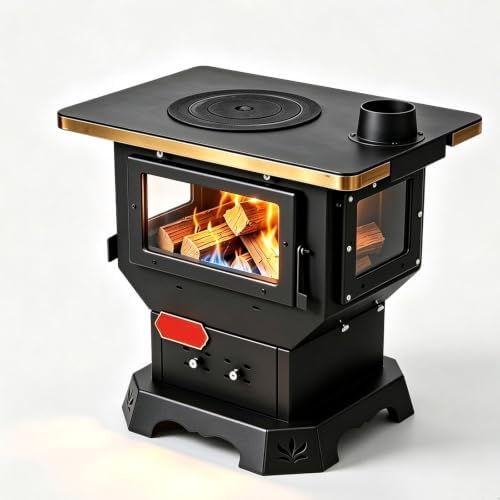
This listing describes a cast-iron stove for heating and cooking, with a recommended coverage area of up to 70 square meters (753 square feet). Its stated fuel options include dry firewood, charcoal, coal, dry branches, straw, and dry leaves. As with any multi-fuel appliance, check the actual manual to see which fuels are permitted for your intended setup.
The stove has three-sided high-temperature glass, a locking door, adjustable air vents, and a large pull-out ash box. The cooktop ring is described as adjustable for cookware such as woks, pans, pots, and kettles. A fire shovel, poker, and tongs are also listed as included accessories. These features make it similar to the first cast-iron option, with much of the appeal centered on cooking and basic fire management.
Its supplied description is very close to the first product’s, so the available information does not establish a clear performance advantage between the two. It also leaves out details such as stove dimensions and chimney requirements. The listing data marks this item unavailable, so confirm that it can be purchased and request complete specifications before planning an installation.
Pros:
- Combines a cast-iron heater with an adjustable cooking surface
- Lists several possible fuel types
- Includes a pull-out ash box and fire tools
- Three-sided glass provides views of the fire
Cons:
- Supplied details do not clearly distinguish it from the other cast-iron option
- The supplied listing data marks this product unavailable
Verdict: This is worth comparing with the LLZJDDPLY model if you want a cast-iron cook stove, but the current supplied details do not show a strong reason to choose it over that similar option.
3. WANGJIANPENGPL Steel Stove: Dual-Fuel Heating with a Side Oven

This steel stove is specified for firewood and coal, rather than the broader set of fuels listed for the cast-iron models. The supplied data gives a heat output of 7 kW and a recommended heating area of 35–50 square meters. Those figures offer a useful comparison point, though your space’s insulation and layout will affect real-world heating needs.
Its cooking setup stands out. The round top can be used for boiling water and cooking, while a small side oven is intended for roasting foods such as potatoes and corn. The stove also has adjustable air controls, a flue damper, and ash-chute air intake. The package is described as including chimney pipes, elbows, a rain cap, and fire tools, but check the exact package contents and assembly instructions before ordering.
Compared with the cast-iron options, this model has a narrower stated fuel range but adds a dedicated side oven and more specific heat-output information. The supplied description does not state its dimensions, required clearances, or the details needed to determine whether its included flue parts suit your installation. The listing data marks it unavailable.
Pros:
- Stated 7 kW output and 35–50 square meter heating area
- Designed for both firewood and coal
- Combines a cooking top with a side roasting oven
- Chimney components and fire tools are listed as included
Cons:
- Its stated fuel options are more limited than those of the cast-iron models
- The supplied listing data marks this product unavailable
Verdict: Choose this as a candidate if you want a wood-and-coal stove with a side oven, but confirm the full installation specifications and included parts before committing.
4. Joaaea Multi-Fuel Stove: A Compact Steel Option for Wood or Pellets

The Joaaea is a steel stove listed for burning wood and pellets. Its stated heating range is 20–50 square meters, making it important to compare the actual size and heat needs of your room with the manufacturer’s guidance. The stove has two viewing windows, an ash drawer, adjustable airflow, and a top opening for warming food or drinks.
The listing describes a four-leg design and a modular chimney system, along with ash-removal tools. A raised base may be useful for the design, but it should not be treated as a substitute for proper floor protection or required clearances. The supplied information does not give a heat-output figure or detailed installation measurements.
This model may suit someone who wants a simpler steel stove and is specifically interested in its stated wood-and-pellet compatibility. It differs from the cast-iron cook stoves, which list more fuel types and more detailed cooking features. Check that the appliance is approved for your intended indoor location and that the chimney system matches the installation. The supplied listing data marks it unavailable.
Pros:
- Listed for wood and pellets
- Two viewing windows and adjustable airflow
- Includes an ash drawer and modular chimney system
- Stated heating range of 20–50 square meters
Cons:
- No heat-output figure or detailed clearances are provided in the supplied data
- The supplied listing data marks this product unavailable
Verdict: Consider this model if wood-and-pellet compatibility and a compact steel design suit your needs, but confirm its indoor-use instructions and installation details first.
5. Greenstovehori 5 Max: An Outdoor Pellet Stove for Hot-Tent Camping

This is an outdoor tent stove, not a like-for-like replacement for the indoor heaters above. Its listing emphasizes pellet use, an oven, and a chimney set for hot-tent camping. The title also identifies wood burning, but the supplied description focuses on pellet operation; confirm the manual’s approved fuels and operating method before use.
The stove has a U-shaped interior intended to retain heat and a larger pellet box. The listing estimates a burn time of about four to ten hours, though actual runtime can vary with fuel, airflow, and setup. It also warns that the pellet setting and chimney damper opening must be matched for normal combustion. The pellet cage is replaceable and may wear with continued high-temperature use.
The main advantage is its specific outdoor use: a tent-oriented design with an oven and included chimney pieces. That makes it a poor fit if you need a permanent indoor home-heating appliance. Follow the manufacturer’s tent and ventilation instructions, and do not use an outdoor stove indoors. The supplied listing data marks this item unavailable.
Pros:
- Designed for outdoor hot-tent camping
- Includes an oven and chimney tube set
- Larger pellet box is intended to support longer burns
- Replaceable pellet cage is identified as a service part
Cons:
- Outdoor tent use makes it unsuitable as a general indoor stove
- Pellet settings and damper position require careful adjustment
Verdict: Consider this only if you need an outdoor tent stove and can follow its pellet and chimney instructions; choose one of the indoor-focused models for home or cabin heating.
How to Choose a Multi-Fuel Wood Stove
Match the stove to your space
Start with the area you want to heat, then compare it with the manufacturer’s stated coverage or output. The products here list different coverage ranges, and only one gives a heat-output figure. These numbers are not guarantees: insulation, room layout, ceiling height, and outdoor temperatures can change how well a stove heats your space. Avoid choosing a stove based on square footage alone.
Check which fuels are actually approved
“Multi-fuel” does not mean every stove can burn every solid fuel. The products in this comparison list different combinations, from wood and pellets to coal, charcoal, and dry plant material. Confirm the approved fuels in the manufacturer’s instructions, and follow local rules. Do not assume that a fuel listed for one stove is safe for another.
Decide whether cooking features matter
If you plan to cook on the stove, look closely at the cooking surface and its controls. Some models have adjustable cooktop rings, while the steel dual-fuel option adds a side oven. A cooking top can be useful in an off-grid setting, but the supplied descriptions do not provide detailed cooking temperatures or oven capacity. Ask for those specifics if they matter to your plans.
Review installation and venting requirements
Before purchasing, get the stove’s exact dimensions, flue size, clearance requirements, floor-protection needs, and installation instructions. Check whether the included chimney parts fit your planned route; an included pipe set does not by itself confirm that it suits your building. Follow local building and fire codes, and consult a qualified installer when needed.
Consider routine cleaning and maintenance
A removable ash drawer or box can make cleanup easier, but it does not remove the need for regular inspection and chimney maintenance. Check how the firebox, glass, ash area, and flue are accessed. For pellet models, find out how to clean the fuel path and whether wear parts—such as the Greenstovehori’s replaceable pellet cage—are available.
Separate indoor heaters from outdoor tent stoves
Choose a stove for its stated setting. The Greenstovehori is presented as an outdoor tent stove, while the other listings describe indoor or indoor/outdoor heating. Do not treat those categories as interchangeable. Use an appliance only in locations and configurations allowed by its manufacturer, with the required ventilation and clearances.
Confirm availability and complete specifications
The supplied data marks all five listings unavailable, so check each product page before making plans. Also confirm the current model, package contents, warranty terms, and full specifications. If important details such as dimensions, heat output, or installation requirements are missing, contact the seller or manufacturer rather than guessing.
Frequently Asked Questions
What does “multi-fuel” mean for a wood stove?
It means the stove is designed to use more than one kind of fuel, but the approved fuels vary by model. Check the exact product instructions rather than assuming that all multi-fuel stoves can burn the same materials.
Can I burn coal in any of these stoves?
The supplied descriptions list coal for the LLZJDDPLY, Generic, and WANGJIANPENGPL models. The Joaaea listing specifies wood and pellets, and the Greenstovehori description focuses on pellets. Always confirm approved fuels in the manufacturer’s manual before use.
Can I use the Greenstovehori tent stove indoors?
It is described as an outdoor hot-tent stove, not a general indoor heater. Use it only in the setting and configuration permitted by its manufacturer, and do not use an outdoor appliance inside a home or other enclosed space unless the manufacturer expressly approves that use.
Which option has the clearest stated heating capacity?
The WANGJIANPENGPL listing provides both a 7 kW heat-output figure and a 35–50 square meter heating-area estimate. The cast-iron models state coverage up to 70 square meters, while the Joaaea lists 20–50 square meters. Compare these figures with your space and ask for more detail if sizing is uncertain.
Do these stoves include chimney parts?
The WANGJIANPENGPL listing describes chimney pipes, elbows, and a rain cap. The Joaaea lists a modular chimney system, and the Greenstovehori includes a chimney tube set. The supplied descriptions do not give enough information to confirm that any included parts will suit a specific building, so check the exact package and installation requirements.
Are the listed stoves currently available?
The supplied product data marks all five listings unavailable. Availability can change, so check the linked product page for the current status before deciding.
Final Recommendation
For a cabin or other suitable space where cooking matters, the LLZJDDPLY cast-iron stove has the broadest stated fuel list and an adjustable cooktop, while the WANGJIANPENGPL is a more focused choice if you want wood-and-coal compatibility plus a side oven. The Joaaea is the option to investigate for wood-and-pellet use, and the Greenstovehori is specifically for outdoor tent use. Since the supplied listings are marked unavailable and key installation details are missing, verify availability, approved fuels, and full specifications before choosing any model.
