
A sit-down shower bath seat can make bathing more manageable when standing for long periods is difficult. The right option depends on your bathroom layout, how much support you need, and whether you need a simple seat or help getting over a tub wall. Compare each chair’s dimensions, height range, weight guidance, and safety features with your own needs before buying.
Table of Contents
Quick Comparison
| Product | Best for | Key features | Stated capacity |
|---|---|---|---|
| Dr. Kay’s Shower Chair | A compact, padded seat | Aluminum frame, side handles, drainage holes | 300 lb |
| Medline Shower Chair with Padded Armrests and Back | Added seated support | Padded armrests and back, adjustable legs | 350 lb |
| CraMAGI Adjustable Shower Chair | A removable backrest | Six height settings, rubber feet, drainage holes | 400 lb frame; 300 lb recommended user weight |
| pxsulliao Swivel Bath Seat | Turning in a smaller bathing space | 360-degree rotating seat, adjustable height | 300 lb |
| DMI Tub Transfer Bench | Getting over a tub wall while seated | Sliding seat, backrest, safety belt | 400 lb |
Our Picks: Best Sit Down Shower Bath reviews
1. Dr. Kay’s Shower Chair: A Compact Padded Seat with Side Handles

This aluminum shower chair is designed for use inside a shower or tub. Its padded seat has drainage holes, and the built-in side handles offer places to grip while sitting or repositioning. The listed seat dimensions are 16.7 by 10.5 inches, so it may suit bathrooms where a wider chair would be hard to fit.
The chair is described as supporting up to 300 pounds and assembling without tools. Its adjustable legs are intended to help you set a suitable seat height. However, the supplied product description gives two different height ranges. Check the current listing and measure your tub or shower before ordering rather than relying on an assumed range.
This is a straightforward choice if you want a seat without a backrest or armrests. That simpler shape can be easier to place in a tight area, but it provides less seated support than the Medline or CraMAGI options. It is not a transfer bench, so it does not help you move over a high tub wall while seated.
Pros:
- Aluminum construction and a stated 300-pound capacity
- Padded seat with drainage holes
- Built-in side handles
- Tool-free assembly and adjustable legs
Cons:
- No backrest or padded armrests
- The supplied description gives conflicting height figures
Verdict: Choose this chair if you want a compact, padded shower seat with handles and do not need a backrest or tub-transfer feature.
2. Medline Shower Chair: Padded Armrests and Back for Seated Support

The Medline chair has a lightweight aluminum frame, padded armrests, and a padded backrest. Those added contact points can be useful if you want more support while seated than a basic stool provides. Slip-resistant feet are designed to help the chair stay in place on a wet bathroom surface.
Its legs adjust from 16 to 21 inches, and the listed weight capacity is 350 pounds. The chair assembles without tools. Compared with the Dr. Kay’s seat, it gives you a backrest and armrests, but its taller minimum seat height may not work as well for every user or tub.
This model is best suited to a shower area with enough floor space for a chair with a back and arms. It is not designed to slide over a tub edge, so measure your bathroom and consider whether you can safely get in and out of the bathing area before choosing it.
Pros:
- Padded backrest and armrests for additional seated support
- Slip-resistant feet
- Adjustable leg height from 16 to 21 inches
- Lightweight aluminum construction and tool-free assembly
Cons:
- Does not provide a tub-transfer feature
- The 16-inch minimum height may be too tall for some users or tubs
Verdict: Pick the Medline if a backrest and padded armrests matter more to you than having a compact, backless seat.
3. CraMAGI Adjustable Shower Chair: Removable Backrest and Flexible Setup
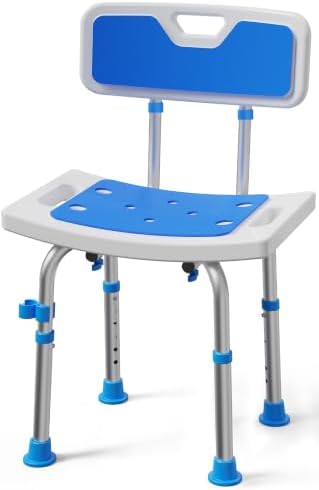
The CraMAGI chair pairs an aluminum-alloy frame with a backrest that can be removed. Keep the back in place for a more supported seat, or take it off to use the chair as a stool. Its legs have six height settings, from 14 to 18.9 inches, and the seat has an anti-slip pad and drainage holes.
The listing states a 400-pound frame capacity but recommends a maximum user weight of 300 pounds. Follow the recommended user limit when deciding whether this chair is appropriate. Wide rubber feet are intended to grip wet floors, and the chair is described as tool-free to assemble and easy to move.
Its removable back makes it more adaptable than the backless Dr. Kay’s chair, while its lower starting height offers a different fit from the Medline. It still does not have armrests or a sliding transfer seat, so consider whether a backrest alone provides enough support for your needs.
Pros:
- Removable backrest lets you switch between chair and stool styles
- Six height settings from 14 to 18.9 inches
- Wide rubber feet and an anti-slip seat pad
- Drainage holes and tool-free setup
Cons:
- The recommended user weight is 300 pounds, despite the higher frame-capacity figure
- No armrests or sliding transfer mechanism
Verdict: Consider the CraMAGI if you want the option of a backrest or a simpler stool, and its recommended user limit suits you.
4. pxsulliao Swivel Bath Seat: A Rotating Design for Tight Spaces

This shower seat has a circular base and a 360-degree rotating design. The product description presents the rotation as a way to make it easier to turn in a bath or shower. Its rounded edges are designed to reduce pinching during turns, and the base is described as suited to smaller tubs and shower spaces.
The height adjusts from 13.75 to 20.5 inches, and the stated capacity is 300 pounds. The rotating seat may be useful if turning your body while seated is difficult, but it is not the same as a transfer bench: the listed features do not include a slide-over-tub mechanism, backrest, or armrests.
The product title describes it as FSA/HSA eligible. Eligibility can depend on your plan and circumstances, so check with your plan administrator before relying on reimbursement. As with any rotating seat, make sure the base fits securely in your bathing area and follow the product’s setup and use instructions.
Pros:
- 360-degree rotating seat
- Height adjusts from 13.75 to 20.5 inches
- Designed for smaller tubs and shower spaces
- Stated capacity of 300 pounds
Cons:
- No backrest or armrests are listed
- Rotation does not provide the same support as a transfer bench
Verdict: Choose this seat if turning in place is a priority and its circular base fits your tub or shower.
5. DMI Tub Transfer Bench: A Sliding Seat for Tub Entry

Unlike the other picks, the DMI is a tub transfer bench. One end sits inside the tub and the other outside, allowing you to sit down before moving across the tub wall. Its seat slides, and the listed features include a backrest, safety belt, strap locks, and suction-cup rubber feet.
The aluminum frame is described as rust-resistant, and the seat height adjusts from 19 to 23.5 inches. The full bench measures 39 inches wide, 18 inches deep, and 37 inches high; the seat is 19 inches wide by 14.5 inches deep. Those larger dimensions make it important to measure both your tub and the nearby floor space before buying.
This bench is the most relevant option here if stepping over the tub edge is the main challenge. It is not as compact as a simple shower stool, and the listed materials include latex, which may matter if you have a latex allergy. The product description also notes that it can be configured for right- or left-side installation.
Pros:
- Sliding design helps with seated transfers over a tub wall
- Backrest, safety belt, strap locks, and suction-cup feet are included
- Right- or left-side setup is possible
- Stated capacity of 400 pounds
Cons:
- Requires more space than a standard shower chair
- Product details state that it contains latex
Verdict: The DMI is the strongest fit when tub entry is the key concern and you have room for a full transfer bench.
How to Choose a Sit-Down Shower Bath Seat
Decide whether you need a chair or a transfer bench
A standard shower chair or stool gives you a place to sit once you are inside the bathing area. A transfer bench is different: it extends across the tub wall so you can sit down outside the tub and move across while seated. If getting over the edge is difficult, compare transfer benches first. A regular chair does not provide that transfer function.
Measure your tub, shower, and available floor space
Measure the bathing area before ordering, including its width, depth, and tub-wall height where relevant. Check the chair’s footprint and seat dimensions against those measurements. A bench such as the DMI needs space both inside and outside the tub, while a compact stool may fit more easily in a smaller shower.
Check seat height and adjustment range
Compare the product’s full height range with the height that lets you sit down and stand up as comfortably as possible. Also consider the tub floor or shower floor, since the same chair can feel different in different bathing setups. If a product description gives conflicting measurements, confirm the details with the seller before purchasing.
Compare support features with your needs
Backrests, armrests, handles, and rotating seats serve different purposes. A backrest may provide support while seated; armrests can offer a place to hold; and a rotating seat may help with turning. These features are not interchangeable, and none should be treated as a replacement for a safe transfer plan.
Understand capacity information
Use the stated recommended user weight when one is provided. For example, the CraMAGI listing gives a 400-pound frame capacity but recommends a 300-pound user limit. Do not rely on a higher frame figure if the product also gives a lower user recommendation. Check the listing for the exact model’s instructions and limits.
Look at feet, drainage, and materials
Rubber or slip-resistant feet and drainage holes are common features among these picks. They can help address wet surfaces and pooled water, but they do not make a bathroom risk-free. Check that all feet rest firmly on a flat surface, assemble the chair as directed, and inspect it regularly. Also review material information for concerns such as latex.
Consider setup and help at home
Tool-free assembly can make setup simpler, but follow the instructions carefully and confirm that all parts are secure before use. If you are unsure whether a chair or transfer method is suitable for your abilities, ask a healthcare professional or occupational therapist for guidance. A caregiver may also need to help with setup or transfers.
Frequently Asked Questions
What is the difference between a shower chair and a tub transfer bench?
A shower chair is used inside the shower or tub. A transfer bench spans the tub wall, with part of the seat outside the tub, so a person can sit and move across while seated. The DMI in this list is a transfer bench; the other options are shower seats or chairs.
Which option has a backrest?
The Medline chair includes a padded backrest, and the CraMAGI chair has a removable backrest. The DMI transfer bench also includes a backrest. The Dr. Kay’s and pxsulliao product descriptions do not list one.
Which chair has the highest listed capacity?
The DMI lists a 400-pound capacity. The CraMAGI lists a 400-pound frame capacity but recommends a maximum user weight of 300 pounds, so follow its lower user recommendation.
Can these seats be used inside a bathtub?
The product descriptions identify these options for shower or tub use, but fit depends on your tub’s dimensions and shape. Measure the space and check each product’s dimensions and installation instructions before ordering.
Does a rotating shower seat replace a transfer bench?
No. A rotating seat is designed to turn in place, while a transfer bench extends across the tub wall. If you need help getting over a high tub edge, look for a transfer bench and confirm that its setup suits your bathroom.
Are these shower chairs safe for every user?
No single chair is right for everyone or every bathroom. Check the user-weight guidance, fit, height range, and features, and follow the product instructions. If you are uncertain about transfers or support needs, ask a healthcare professional for advice.
Final Recommendation
For a simple padded seat, consider the Dr. Kay’s chair after confirming its height details. Choose the Medline if you want padded armrests and a back, or the CraMAGI if you value a removable backrest and its recommended user limit fits. The pxsulliao seat stands out for its rotating design. If getting over a tub wall is the main challenge, the DMI transfer bench is the most purpose-built option in this group. Measure your space and check the product instructions before deciding.
