
A smart indoor trainer can turn Zwift rides into structured workouts, virtual races, or a reliable way to ride when you can’t get outside. The five direct-drive options below include Wahoo trainers with Zwift Cog setups, cassette-equipped models, and Elite’s Avanti. The right choice depends on how you want to shift, what connectivity you need, and whether the trainer’s power and climb specs match your goals.
Table of Contents
Quick Comparison: Smart Indoor Bike Trainers for Zwift
| Trainer | Standout features | Best fit |
|---|---|---|
| Wahoo KICKR CORE 2 with Zwift Cog and Click | Zwift Cog and Click virtual shifting; Wi-Fi | Riders who want a Zwift-focused setup |
| Wahoo KICKR CORE 2 with 11-Speed Cassette | 11-speed cassette; Wi-Fi | Riders who prefer a conventional cassette setup |
| Wahoo KICKR V6 with Zwift Cog and Click | More than 2,200 watts; ±1% accuracy; Wi-Fi | Hard training and virtual shifting |
| Wahoo KICKR V6 with 11-Speed Cassette | 2,200 watts; ±1% accuracy; up to 20% grade simulation | Riders seeking high performance with a cassette |
| Elite Avanti Direct Drive Smart Trainer | ±1% accuracy; Wi-Fi, Bluetooth, and ANT+ | Riders who want broad app and device connectivity |
Our Picks: Best Smart Indoor Bike Trainers For Zwift reviews
Wahoo KICKR CORE 2 with Zwift Cog and Click: A Zwift-First Setup

This KICKR CORE 2 bundle pairs Wahoo’s direct-drive trainer with a Zwift Cog and Click virtual shifting. That makes it the most Zwift-specific option in the CORE 2 lineup here: it is designed for riders who want to change gears through the virtual shifting setup rather than rely on a conventional trainer cassette.
Wahoo says the updated CORE adds easier setup and improved connectivity, including integrated Wi-Fi for pairing and automatic updates when connected to an active network. The trainer is also built around the smooth resistance and road-like ride feel associated with the KICKR CORE line. Those features suit structured sessions as well as casual virtual rides.
The main trade-off is that the Cog and Click configuration is specialized around virtual shifting. If you expect to move between Zwift and other training platforms, or prefer to shift with your bike’s usual drivetrain, compare it with the cassette-equipped CORE 2. As with any trainer, check that your bike and the setup are compatible before ordering.
Pros:
- Zwift Cog and Click virtual shifting are included in this configuration.
- Integrated Wi-Fi supports pairing and automatic updates.
- Designed for smooth resistance and structured training.
- Offers a direct-drive option in Wahoo’s CORE line.
Cons:
- The virtual-shifting setup may be less appealing if you prefer a standard cassette.
- Bike compatibility should be checked before purchase.
Verdict: Choose this KICKR CORE 2 if Zwift is your main platform and you want the Cog and Click setup from the start.
Wahoo KICKR CORE 2 with 11-Speed Cassette: A Familiar Drivetrain Choice

This version of the KICKR CORE 2 comes with an 11-speed cassette instead of a Zwift Cog and Click setup. That makes it a straightforward choice if you want your bike’s gearing to work through a conventional cassette arrangement while using Zwift or another compatible training app.
The CORE 2’s listed features include integrated Wi-Fi, faster pairing, and automatic updates when connected to an active Wi-Fi network. Wahoo also describes its resistance as smooth and suited to hard efforts and structured training. The direct-drive design keeps the trainer itself at the center of your indoor setup, while the included cassette saves you from sourcing one separately.
Before buying, confirm that an 11-speed cassette is a suitable match for your bike’s drivetrain. This model does not include the Zwift Cog and Click arrangement found on the other CORE 2 option in this guide, so it may not be the best fit if virtual shifting is your priority.
Pros:
- Includes an 11-speed cassette.
- Integrated Wi-Fi supports pairing and automatic updates.
- Designed for steady resistance during workouts and virtual rides.
- A conventional cassette setup may suit riders who prefer familiar shifting.
Cons:
- Check that the included cassette matches your bike’s drivetrain needs.
- Does not offer the Zwift Cog and Click setup listed with the other CORE 2 option.
Verdict: Pick this version if you want a KICKR CORE 2 with an included 11-speed cassette and do not need the Zwift Cog and Click bundle.
Wahoo KICKR V6 with Zwift Cog and Click: High-Power Virtual Riding

This KICKR V6 configuration combines Wahoo’s higher-spec smart trainer with a pre-installed Zwift Cog and Click virtual-shifting setup. It is aimed at Zwift riders who want that style of gear changes along with the V6’s stated power and connectivity features.
Wahoo lists resistance above 2,200 watts and power accuracy within ±1%. Wi-Fi provides a connection for sending ride data to a computer, tablet, or phone, while the trainer’s high-inertia flywheel, algorithms, and KICKR AXIS feet are designed to create a more road-like ride feel. The AXIS feet allow some side-to-side movement, rather than making the trainer feel completely rigid.
This model makes the most sense for riders who will use its performance headroom and want virtual shifting. If you mainly ride easy sessions or want a conventional cassette setup, the CORE 2 or cassette-equipped V6 may be a better match. The listed details do not specify a simulated gradient for this Cog version, so compare the exact product configuration if climb simulation is a key requirement.
Pros:
- Includes a pre-installed Zwift Cog and Click virtual shifting.
- Power accuracy is listed at ±1%.
- More than 2,200 watts of resistance is specified.
- Wi-Fi and KICKR AXIS feet add connectivity and some side-to-side movement.
Cons:
- Its higher performance features may be more than casual riders need.
- The listed product details do not specify a simulated gradient for this configuration.
Verdict: Choose the V6 Cog version if you want Zwift virtual shifting and value the trainer’s stated high power and precision specifications.
Wahoo KICKR V6 with 11-Speed Cassette: Performance with Climb Simulation
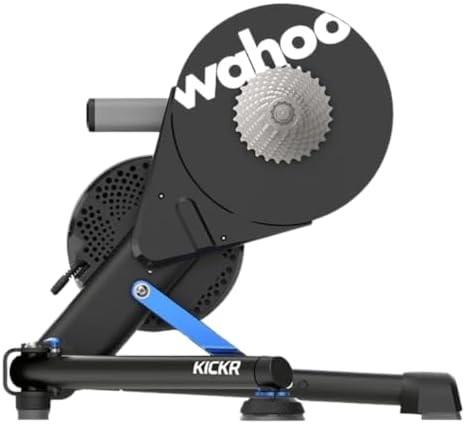
This KICKR V6 package includes an 11-speed cassette and is the cassette-based alternative to the V6 Cog model. Its listed specs include up to 2,200 watts of resistance, ±1% power accuracy, and simulated gradients up to 20%. That combination gives riders clear performance targets to compare when choosing a trainer for demanding Zwift sessions.
The trainer connects over 2.4 GHz Wi-Fi and uses a high-inertia flywheel, advanced algorithms, and KICKR AXIS feet to shape its ride feel. Wahoo also lists automatic calibration, which is intended to maintain accurate power readings without a separate manual calibration routine. The AXIS feet add some side-to-side motion to the setup.
Unlike the Cog model, this version is built around a standard 11-speed cassette. That may be a better fit if you want conventional shifting, but it makes drivetrain compatibility important. The V6’s extra power capacity and climb simulation can be useful for hard efforts; for a more basic indoor routine, the CORE 2 may offer a more suitable feature set.
Pros:
- Includes an 11-speed cassette.
- Lists up to 2,200 watts of resistance and ±1% power accuracy.
- Simulates gradients up to 20%.
- Wi-Fi connectivity and automatic calibration are included in the listed feature set.
Cons:
- Confirm the 11-speed cassette is compatible with your bike’s drivetrain.
- It does not include the Zwift Cog and Click setup.
Verdict: This is the stronger match if you want the V6’s stated power and climb specs with a conventional cassette rather than virtual shifting.
Elite Avanti Direct Drive Smart Trainer: Broad App Connectivity

The Elite Avanti is a direct-drive smart trainer with a focus on precise power measurement and flexible connections. Its integrated Optical Torque Sensor is specified at ±1% accuracy. The trainer is rated for up to 2,100 watts and can simulate climbs up to 18%, putting its performance figures between the two Wahoo product lines covered here.
Connectivity is a central strength: the Avanti supports Wi-Fi, two Bluetooth channels, and ANT+ FE-C. That range can help if you want to connect with Zwift while also using compatible devices or apps. Elite lists compatibility with several training platforms, along with 10Hz data transmission, automatic calibration, and Wi-Fi firmware updates.
The setup includes quick-release and thru-axle adapters for the listed sizes, a carry handle, and an integrated storage compartment. It can also work without an app or power source, according to the supplied product details. Elite notes that the Zwift Cog can be removed to use a standard cassette, giving the setup flexibility for different platforms. Check the included adapters and your bike’s axle fit before purchase.
Pros:
- ±1% power accuracy is specified through the integrated Optical Torque Sensor.
- Supports Wi-Fi, dual Bluetooth, and ANT+ FE-C.
- Lists up to 2,100 watts of power and 18% gradient simulation.
- Includes adapters, a carry handle, and an integrated storage compartment.
Cons:
- Its broad feature set may be unnecessary if you only need basic Zwift connectivity.
- Confirm your bike’s axle type and fit against the included adapter specifications.
Verdict: Consider the Avanti if you value multiple connection options, detailed power specs, and the ability to use it with a range of training platforms.
How to Choose a Smart Indoor Bike Trainer for Zwift
Decide Between a Zwift Cog and a Cassette
A Zwift Cog and Click setup is designed around virtual shifting, so it can be a natural choice if Zwift is where you expect to spend most of your indoor riding time. A cassette-equipped trainer uses a conventional gearing setup instead. Think about how you want to shift and whether you plan to use other apps before choosing between them. In either case, check that your bike’s drivetrain works with the trainer configuration.
Check Bike Fit and Axle Compatibility
Direct-drive trainers connect to your bike at the rear wheel position, so the bike’s axle type and the trainer’s supplied hardware matter. The Elite Avanti listing specifies quick-release and 142x12mm thru-axle adapters. For any model, confirm the product’s current fit details against your bike before ordering; do not assume that a cassette or adapter will suit every drivetrain and frame.
Match Power and Climb Specs to Your Riding
Power capacity and gradient simulation matter most when you plan to do hard intervals, virtual races, or sustained climbs. The listed Wahoo V6 cassette version reaches 2,200 watts and simulates gradients up to 20%, while the Elite Avanti lists 2,100 watts and gradients up to 18%. The CORE 2 descriptions focus more on smooth resistance and structured training. Higher specifications can be useful, but they are not essential for every indoor rider.
Choose the Connectivity You Need
All of these options are presented as smart trainers for app-based riding, but their connection details differ. The Wahoo models highlight Wi-Fi, while the Avanti lists Wi-Fi, Bluetooth, and ANT+ FE-C. Consider the device you plan to run Zwift on and any other bike computers or training apps you use. A broader selection of connection types can be helpful if you want to connect more than one compatible device.
Consider Setup and Ongoing Use
A trainer should be practical to set up, connect, and use in your riding space. The CORE 2 descriptions point to easier setup and Wi-Fi-supported updates. Elite lists a carry handle and integrated storage compartment on the Avanti. Also consider whether you are comfortable setting up a cassette or prefer a Cog-based option, and make room for the bike and trainer where you plan to ride.
Spend on Features You Will Use
The KICKR V6 models have higher stated power and additional features compared with the CORE 2 options. The Avanti stands out for connection choices and its specified power accuracy. If your typical rides are steady and recreational, a simpler CORE 2 configuration may be enough. If you race, train with structured power targets, or switch between apps and devices, the more detailed specifications may matter more.
Frequently Asked Questions
Which trainer in this guide is the best fit for Zwift virtual shifting?
The Wahoo KICKR CORE 2 with Zwift Cog and Click is the more direct choice if you want a Zwift-focused Cog setup at the CORE level. The KICKR V6 Cog model also includes Zwift Cog and Click, with higher stated power specifications.
What is the difference between the KICKR CORE 2 versions listed here?
One version includes a Zwift Cog and Click virtual-shifting setup, while the other is supplied with an 11-speed cassette. Choose based on the shifting approach you prefer and your bike’s drivetrain compatibility.
Is an 11-speed cassette compatible with every bike?
No single cassette setup should be assumed to fit every bike. Check your drivetrain and the trainer’s product details before buying, especially if you are choosing a cassette-equipped model.
Does the Elite Avanti work with Zwift?
The supplied product information lists Zwift among the compatible training apps. It also lists Wi-Fi, Bluetooth, and ANT+ FE-C connectivity.
Do these trainers require Wi-Fi?
The Wahoo product details describe Wi-Fi for connection and updates, and the Elite Avanti also lists Wi-Fi. Elite additionally lists Bluetooth and ANT+ FE-C. Check the setup instructions for the specific trainer and device you plan to use.
Should I choose the KICKR CORE 2 or KICKR V6?
The CORE 2 is aimed at riders who want the listed CORE ride feel and features, while the V6 models offer higher stated power specifications and, for the cassette version, up to 20% gradient simulation. Choose based on your training demands and the features you will use.
Final Recommendation
For most Zwift-focused riders choosing between these setups, the Wahoo KICKR CORE 2 with Zwift Cog and Click is the clearest starting point because it is configured for virtual shifting. Choose the KICKR V6 with an 11-speed cassette if you want its stated power and climb specifications with conventional gearing, or consider the Elite Avanti if multiple connection types and broader app flexibility are priorities. Before ordering, confirm that the trainer’s shifting setup and adapters fit your bike.
