
Indoor air quality monitors can help you spot changes in particles, gases, humidity, and temperature—but no single device measures everything. The right choice depends on what you want to track: carbon dioxide for ventilation, radon for a specific home concern, or a wider mix of air-quality readings. These five options range from simple Alexa-connected monitoring to detailed, app-based systems.
Table of Contents
Quick Comparison
| Product | What it measures | Best suited for | Availability |
|---|---|---|---|
| Amazon Smart Air Quality Monitor | PM2.5, VOCs, carbon monoxide, humidity, temperature | Alexa households seeking simple alerts and routines | Listed as available |
| Aranet4 Indoor Air Quality Monitor | CO2, temperature, relative humidity, atmospheric pressure | Monitoring ventilation without a power cable | Listed as available |
| Airthings View Plus | Radon, PM2.5, CO2, VOCs, humidity, temperature, air pressure | Tracking radon alongside several other readings | Listed as available |
| AprilAire ZAWTHCPV Smart Indoor Air Quality Monitor | CO2, VOCs, TVOC, PM2.5, humidity, temperature | App guidance and compatible AprilAire systems | Listed as available |
| AirGradient ONE | PM2.5, CO2, TVOC, NOx, temperature, humidity | Detailed readings and open-source smart-home options | Listed as unavailable |
Our Picks: Best Indoor Air Quality Monitors reviews
Amazon Smart Air Quality Monitor: Best for Alexa Households

Amazon’s monitor tracks five factors: PM2.5 particles, VOCs, carbon monoxide (CO), humidity, and temperature. A color-coded light gives you a quick status check, while the Alexa app shows an air-quality score and more detail.
Its main advantage is how it fits into an Alexa home. You can receive phone notifications or announcements on Echo devices, and Alexa Routines can switch compatible devices such as air purifiers, dehumidifiers, and fans on or off when readings change. The temperature sensor can also work with an Amazon Smart Thermostat.
This is a practical choice if you already use Alexa and want alerts or basic automation without managing a separate system. It does not measure CO2, however, so it is not the pick for tracking ventilation through carbon-dioxide readings. Also, a monitor is not a replacement for a dedicated, properly installed carbon-monoxide alarm.
Pros:
- Tracks particles, VOCs, CO, humidity, and temperature
- Offers an at-a-glance light and readings in the Alexa app
- Can trigger Alexa announcements and device routines
- Temperature readings can support an Amazon Smart Thermostat setup
Cons:
- Does not measure CO2 or radon
- Its smart features are most useful in an Alexa-connected home
Verdict: Choose the Amazon Smart Air Quality Monitor if you want straightforward readings and Alexa-based alerts, but look elsewhere if CO2 or radon is a priority.
Aranet4: Best for Portable CO2 and Ventilation Checks

The Aranet4 focuses on CO2, with additional readings for temperature, relative humidity, and atmospheric pressure. Its CO2 measurement uses a nondispersive infrared (NDIR) sensor, and the display uses color coding to help you notice when CO2 is high.
The e-ink display and battery-powered design make it a good fit for rooms where you do not want another cable. The manufacturer lists battery life of up to four years. An optional buzzer can provide another alert, while the app offers graphs and up to 90 days of historical data.
CO2 readings can help you notice when a room may need more ventilation, but this device does not measure particles, VOCs, carbon monoxide, or radon. That narrower focus is a strength for people who mainly want to monitor ventilation, but a limitation if you want a broad view of indoor pollutants.
Pros:
- Uses an NDIR sensor to measure CO2
- Tracks temperature, humidity, and atmospheric pressure too
- Battery-powered design avoids a power cable
- App graphs show historical readings
Cons:
- Does not measure PM2.5, VOCs, carbon monoxide, or radon
- Its focus is narrower than the multi-pollutant options here
Verdict: The Aranet4 is a strong fit if portable CO2 monitoring is your main goal and you do not need a broad set of pollutant readings.
Airthings View Plus: Best for Radon and Broad Monitoring

The Airthings View Plus measures radon, PM2.5, CO2, VOCs, humidity, temperature, and air pressure. That range makes it one of the broadest options in this group, especially for households that want to monitor radon alongside everyday air conditions.
It is battery-powered and has a customizable e-ink screen. The Airthings app is required, and the monitor also needs internet access for its connected features and cloud-based data tracking. The app displays readings and trends, and can send notifications when conditions warrant attention.
The added radon measurement is the main reason to choose this model over the Amazon or Aranet4 monitors. Its broader sensor mix also means it can be useful when you want to compare changes across several readings. In return, it relies on an account, app, and internet connection, so it is less appealing if you prefer a fully offline setup.
Pros:
- Measures radon along with PM2.5, CO2, and VOCs
- Also tracks humidity, temperature, and air pressure
- Battery-powered with a customizable e-ink display
- App provides readings, trends, and notifications
Cons:
- Requires the Airthings app, an account, and internet access
- Its app and cloud requirements may not suit users seeking local-only monitoring
Verdict: Pick the View Plus if radon monitoring and a wide range of air readings matter more to you than app-free operation.
AprilAire ZAWTHCPV: Best for App Guidance and AprilAire Integration

This Wi-Fi monitor measures CO2, VOCs, TVOC, PM2.5, humidity, and temperature. Its color status display is designed to make readings easier to understand at a glance, while the Healthy Air app provides values, trends, alerts, explanations, and suggestions for addressing air-quality concerns.
The unit offers three light settings: default, always on, or always off. That gives you some choice over how visible the indicator is in a room. The monitor is designed to work with certain AprilAire filtration and ventilation solutions, but the listed Healthy Air Mode integration requires a compatible AprilAire Wi-Fi thermostat sold separately.
This is a good match for someone who wants more context than a raw number and may already use compatible AprilAire equipment. It does not measure radon or carbon monoxide, and its app is required for operation. If you want to avoid Wi-Fi or are not interested in the AprilAire ecosystem, the Aranet4 or a non-connected option may be a better fit.
Pros:
- Tracks CO2, VOCs, TVOC, PM2.5, humidity, and temperature
- App offers trend information, explanations, and alerts
- Three light settings let you adjust the status indicator
- Can integrate with compatible AprilAire equipment
Cons:
- Requires the Healthy Air app to function
- Some system integrations require a compatible thermostat sold separately
Verdict: Choose the AprilAire if you want app-based explanations and may connect it with compatible AprilAire equipment; skip it if you want radon or carbon-monoxide readings.
AirGradient ONE: Best for Detailed Readings and Open Integration
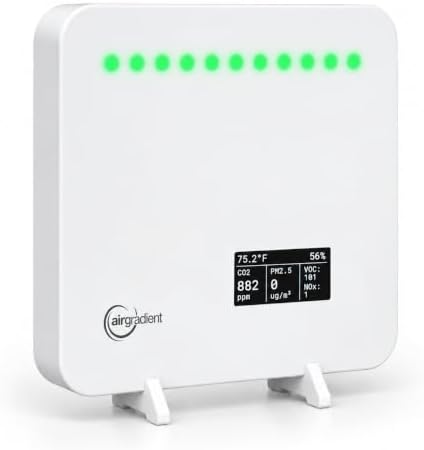
The AirGradient ONE measures PM2.5, CO2, TVOC, NOx, temperature, and humidity. It has a small OLED display for current readings and an LED color bar for a quick visual check. The listed sensor package includes an NDIR CO2 sensor, a laser particle sensor, and sensors for TVOC and NOx.
Its software options are a key difference. The product includes access to a dashboard, an API, and an app without a subscription, and it supports local integrations such as Home Assistant. Open-source hardware and firmware also give technically minded users more control over how the monitor is used. It can sit on a flat surface or be mounted on a wall.
The AirGradient ONE does not measure radon or carbon monoxide, and the supplied listing indicates that it is unavailable. Check its listing before planning a purchase. If it becomes available, its mix of display readings, local integration, and subscription-free access makes it a compelling choice for people who want more control than a basic app-connected monitor offers.
Pros:
- Measures PM2.5, CO2, TVOC, NOx, temperature, and humidity
- Includes an OLED display and color indicator bar
- Offers dashboard, app, and API access without a subscription
- Supports local smart-home integration and open-source options
Cons:
- Listed as unavailable, so it may not be an immediate buying option
- Does not measure radon or carbon monoxide
Verdict: Keep the AirGradient ONE on your shortlist if you value detailed readings and local smart-home control, but confirm it is available before choosing it.
How to Choose an Indoor Air Quality Monitor
Start with the pollutant or condition you want to track
There is no single sensor that covers every indoor air concern. CO2 readings can help you assess ventilation, while PM2.5 readings track fine particles. VOC readings can show changes related to gases and fumes, and a radon sensor is useful when you specifically want to monitor radon. Make a short list of your priorities before comparing devices, and check each product’s sensor list carefully.
Know the difference between CO and CO2
Carbon monoxide (CO) and carbon dioxide (CO2) are different gases, and monitors may measure one without measuring the other. The Amazon monitor in this guide lists CO, while the Aranet4 measures CO2. Do not assume that a device with one reading covers the other. An air-quality monitor should not take the place of a dedicated carbon-monoxide alarm.
Decide how much app and smart-home access you want
Connected monitors can provide alerts, reading history, and automation, but they may require an app, internet access, or an account. The Amazon model is designed around Alexa features, while the Airthings and AprilAire devices require their respective apps. AirGradient offers local integration options, and the Aranet4 pairs a display with an optional app. Choose based on how you want to check readings day to day.
Consider where you will place the monitor
Think about whether the device will stay in one room or move between spaces. A battery-powered monitor can be easier to place without a nearby outlet, while a connected device may need a reliable Wi-Fi connection. Also consider whether you want a screen on the unit, a color indicator, or readings you check mainly through an app.
Look for readings you can act on
A monitor is most useful when its readings help you decide what to do next. An alert or trend can prompt you to ventilate a room, investigate a source, or use compatible air-treatment equipment. App explanations may help make measurements easier to understand, but no monitor can identify every possible source of poor air. Treat readings as useful information, not a diagnosis or a complete safety system.
Check ongoing requirements and compatibility
Before buying, confirm whether the monitor needs Wi-Fi, a phone app, an account, or a compatible thermostat or other equipment for the features you want. Some devices include a broader set of readings but depend more on connected services. Others are simpler and focus on one area, such as CO2. A close match for your home is usually more useful than the device with the longest feature list.
Frequently Asked Questions
What should an indoor air quality monitor measure?
That depends on your goal. CO2 can help you monitor ventilation, PM2.5 tracks fine particles, and VOC readings cover a range of airborne compounds. If radon is a concern, choose a model that specifically lists radon measurement. Compare the sensor list with the issues you want to monitor rather than assuming every device measures the same things.
Is CO the same as CO2 on an air quality monitor?
No. CO is carbon monoxide, while CO2 is carbon dioxide. They are separate measurements. Check the product specifications to confirm which one a monitor detects, and use a dedicated carbon-monoxide alarm for CO safety.
Can an air quality monitor tell me when to ventilate?
A monitor with CO2 readings can help you notice changes that may point to a need for more ventilation. Models with alerts or trend graphs can make those changes easier to follow. The readings are a guide, though, and they do not replace good ventilation practices or explain every cause of poor air.
Do indoor air quality monitors measure radon?
Some do, but many do not. Of the products here, the Airthings View Plus lists radon measurement. Check the exact sensor list before buying if radon is one of your main concerns.
Do these monitors need Wi-Fi?
Requirements vary. The Airthings View Plus requires internet access for its connected features, and the AprilAire monitor requires its app to function. The Amazon model uses Alexa features, while the AirGradient ONE supports local integration options. The Aranet4 can show readings on its display and also offers an app.
Can an air quality monitor replace a carbon-monoxide alarm?
No. An air-quality monitor is not a substitute for a dedicated carbon-monoxide alarm. Follow the alarm manufacturer’s installation and maintenance instructions, and use the appropriate safety device for CO protection.
Final Recommendation
For Alexa households, the Amazon Smart Air Quality Monitor offers a simple route to readings and automated alerts. Choose the Aranet4 if CO2 and ventilation are your main concerns, or the Airthings View Plus if radon measurement and a broader sensor mix matter most. The AprilAire is a sensible option for app guidance and compatible system integration. AirGradient offers appealing local-control features, but its listing is marked unavailable, so confirm availability before making it your pick.
