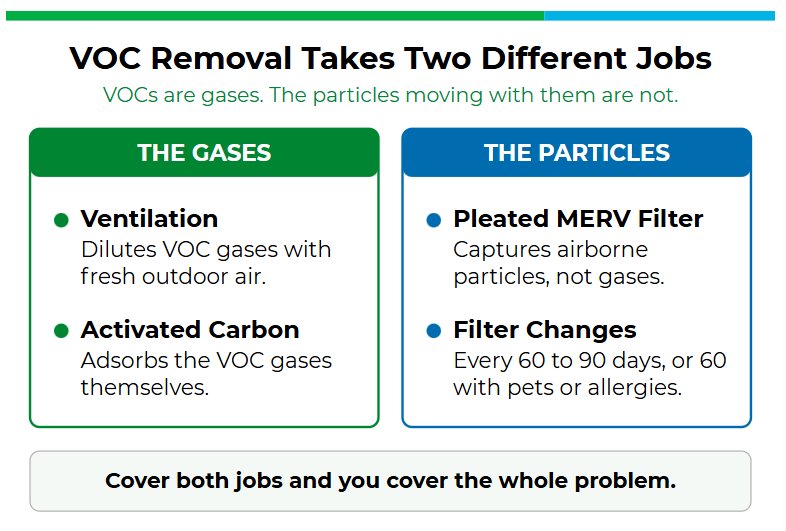
Installing a charcoal filter for bathroom fan essential air quality solution takes about 20 to 30 minutes, costs very little for sheet material, and rates as medium difficulty because it requires careful ladder balance. You must have your fan housing dimensions before starting. The trade-off is clear: adding carbon media traps volatile organic compounds and sewer gas, but it adds static pressure that slows moisture removal.
Table of Contents
Essential charcoal filter supplies
| Item | How much | Why it’s needed | A substitute |
|---|---|---|---|
| Cut-to-fit activated carbon sheet | 1 sheet | Adsorbs gaseous odors and chemical vapors | none — don’t swap this |
| Measuring tape | 1 tool | Measures fan grille and duct opening | Ruler |
| Heavy-duty scissors | 1 pair | Cuts carbon sheet to exact size | Utility knife |
| Step stool or ladder | 1 unit | Allows safe access to ceiling unit | none — don’t swap this |
| Painter tape | 1 roll | Temporarily secures media without residue | none — don’t swap this |
| Dust mask | 1 piece | Blocks loose carbon dust during cuts | Bandana |
Before you start
- Turn off the bathroom circuit breaker at the main electrical panel; never rely solely on the wall switch.
- Clear all bath mats, toiletries, and laundry baskets directly below the exhaust fixture.
- Place your step stool on flat, dry flooring directly under the fan housing.
- This setup isn’t for ductless fans venting into unconditioned attics, which require professional metal duct routing.
- Don’t touch exposed wire splices inside the metal housing; if you see damaged insulation or loose wire nuts, stop and hire a licensed electrician.
Step by step
-
Switch off the dedicated branch circuit at your home electrical service panel. Check the fan wall switch twice to verify zero electrical power reaches the ceiling unit.
-
Pull the plastic ceiling grille downward by 2 to 3 inches until metal tension springs become visible. You’ll see two V-shaped wire clips resting inside metal housing slots.
-
Squeeze the metal wire springs together with your fingers to release the grille entirely from the ceiling box. Lower the plastic cover carefully to the floor.
-
Measure the interior flat perimeter of the grille intake opening using your tape measure. Write down the length and width numbers directly on a notepad.
-
Mark those exact flat measurements onto your activated carbon sheet using a light pencil line. Double-check your numbers against the plastic housing before making any cut.
-
Cut the activated carbon fabric along your pencil lines using sharp shears. Keep the thickness under one-quarter inch so the motor doesn’t overheat from restricted airflow.
-
Press the cut carbon square against the interior backside of the grille using four 2-inch strips of painter tape. Ensure no loose edges drape down to touch the motor.
-
Squeeze the grille spring wires back into the ceiling slots and slide the cover flush to the drywall. The faceplate must sit flat against your painted ceiling surface.
How to know it worked

The installation is successful when the grille sits flush with the ceiling, the fan motor runs without a rattling hum, and room air draws through the media smoothly. Hold a single ply of toilet paper against the cover; the fan should hold it flat against the surface within 2 seconds. According to the EPA indoor air quality guidance, removing pollutant sources alongside proper mechanical ventilation maintains safe indoor environments. If moisture lingers on your bathroom mirror for longer than 20 minutes after a shower, the carbon layer is choking the airflow. A faint chemical smell also indicates air is escaping around the edges of the media rather than flowing through it.
If something goes wrong
| What happened | Why | What to do |
|---|---|---|
| Fan hums very loudly | Media touches spinning fan blades | Reposition sheet flat against grille |
| Mirror stays foggy long | Carbon sheet is too dense | Switch to thinner porous media |
| Grille falls from ceiling | Spring clips missed housing slots | Reinsert tension wires securely |
| Black dust blows out | Cut edge shed loose particles | Vacuum edges before remounting cover |
| Wall switch trips breaker | Wire pinched behind metal frame | Turn off breaker; call electrician |
How often to do this
Replace the carbon pad regularly for typical residential usage. The actual lifespan varies by model — check the label on your replacement material for the manufacturer limit. Two main variables change this timeline faster than anything else: household size and shower habits. Daily hot steam saturates the microscopic pore network of activated carbon with water vapor, preventing it from binding odors. A home where four people take daily showers exhausts a filter pad twice as fast as a single-person home. If bathroom humidity stays above 60 percent regularly, change the pad as part of your usual clean to prevent surface mildew.
Frequently asked questions

Can I put a charcoal filter in any bathroom fan?
Yes, as long as the fan housing allows at least one-quarter inch of clearance away from the spinning blower wheel. Most common exhaust models accept an added sheet behind the grille, but you must ensure the motor rating supports the added airflow resistance without overheating.
Does it matter which way the filter faces?
No, plain cut-to-fit activated carbon fabric works the same in either direction because carbon particles are distributed evenly throughout the web. If your specific pad has a white dust layer on one side, place the white side facing the room to trap dust before odors reach the carbon.
What happens if the charcoal sheet gets wet?
Water drops fill up the open microscopic pores of the activated carbon, completely blocking its ability to capture gaseous odors. Once regular shower steam saturates the carbon binder, the sheet stops cleaning the air and must dry out fully before it functions again.
Why is my bathroom fan suddenly running hotter?
The carbon sheet you installed is likely too thick, which creates excessive static pressure against the fan blades. Check your fan model documentation; if X is a low-power motor under 50 CFM, use a very thin open-weave pad; if Y is 110 CFM, standard density works fine.
How long does a charcoal insert last?
About 90 days under standard residential use with two daily showers. A common mistake people make is washing spent carbon pads in soapy water, which permanently ruins the porous binder and costs them the price of a brand-new replacement sheet.
Is it safe to leave the fan running all day?
No, continuous operation creates excess wear on non-continuous rated motors and draws conditioned air out of your house. Standard bathroom fans should run for 20 minutes after a bath or shower to extract steam, then shut off completely to prevent motor strain.
Final Thoughts
Once you’ve finished the installation, keep an eye on your bathroom’s humidity levels for a few days. If the mirror stays foggy longer than usual, you might need to upgrade your fan motor later on. It’s a simple trade-off, but you’ll definitely enjoy fresher, cleaner air in your home.
Related guides
- Bathroom Fan With Humidity Sensor: How to Choose and Install
- Bathroom Fan Not Working Well: Simple Fixes for Better Airflow
- Bathroom Sink Stopper Replacement: A Simple DIY Guide