
Warehouse clubs like Costco and Sam’s Club offer the cheapest place to buy toilet paper and paper towels when you calculate the cost per sheet. If you don’t have a paid membership, big-box stores like Walmart beat regular supermarkets by selling large multi-packs under their store brand labels like Great Value.
Total package prices fool shoppers because roll sizes are never uniform across brands. A package marked “12 equals 48 rolls” means nothing until you check the total square footage printed on the bottom corner.
Buying paper products at regular grocery or drugstores costs significantly more per square foot. Those stores rely on convenience shoppers who grab small packs without checking unit rates.
Table of Contents
Finding the lowest unit price
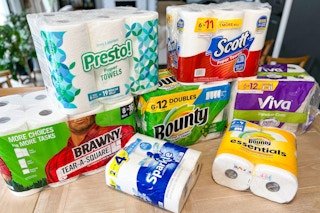
- Check the bottom front of the plastic wrap for the total square footage or sheet count instead of counting rolls. Packages use terms like “mega” or “super” that don’t match any legal measurement standard.
- Divide the shelf price by the total square feet using your phone calculator to find the cost per unit.
- Compare the store’s private label against the national brand sitting right next to it. You’ll get the exact same raw paper pulp in many store brands, but at a lower shelf price because you aren’t paying for national advertising.
- If you have room to store 30 rolls, buy the largest bulk bundle available; if you live in a small apartment without deep closets, stick to smaller multi-packs to avoid cluttering your living space. Tip: Never stack open paper rolls directly on damp basement floors where cardboard tubes absorb moisture.
- Watch the ply rating before you head to the register. The trade-off with thin 1-ply rolls is that people double their sheets, which burns through cheap rolls twice as fast.
- Verify your final register receipt against the shelf tag before you leave the parking lot. Tip: Price tags on paper aisles often get shifted under the wrong pack size.
How long it takes
Price checking your usual brands takes just a few minutes once you know where to look.
| Situation | How long | What changes it | What to watch for |
|---|---|---|---|
| In-store shelf comparison | 2 to 3 minutes | Crowded aisles or missing shelf tags | Mismatched tags on different roll sizes |
| Ordering bulk delivery online | 5 to 10 minutes | Adding extra items to meet free shipping rules | Hidden shipping fees that wipe out roll discounts |
| Warehouse club shopping | 30 to 45 minutes | Checkout lines and loading heavy packs into your car | Buying brand names over store labels by mistake |
If shelf tags are missing or damaged, scan the barcode with the store’s mobile app to pull up the unit price instantly.
How to tell when it’s done
You know you’ve found the true bargain when the cost per 100 sheets beats every other store in your town. This varies by model — check the label on every pack, because manufacturers frequently shrink sheet counts while keeping outer packaging identical. A solid bargain also means buying products that don’t shred during use. The Federal Trade Commission guidelines on packaging require manufacturers to print net quantity in square feet on every package, giving you the single reliable number you need to settle price debates.
Mistakes that ruin it
- Counting rolls instead of total square footage: You end up paying more for less material because roll thickness varies wildly across manufacturers. Look exclusively at the total square feet printed on the outer label.
- Buying single-ply paper to save money: Thin sheets force household members to use three times more product per wipe. Choose strong two-ply store brands to keep your total monthly consumption low.
- Letting membership fees sit unused: A warehouse club membership costs real money every year, and shopping there only once or twice wastes that investment. Who this isn’t for: single individuals who can’t store giant bundles and rarely use enough paper to justify annual club dues.
Frequently asked questions
Can you save money buying paper products online?
Yes, if you use subscription services or buy store brands with free shipping. However, shipping heavy bundles often adds delivery surcharges that erase the savings you get from physical club stores.
Why do toilet paper rolls look smaller now?
Manufacturers reduce sheet counts or narrow the roll width to keep shelf prices steady during periods of inflation. This practice, known as shrinkflation, lowers the total square footage without visibly changing package dimensions.
Is generic paper towel as absorbent as name brands?
No, bargain paper towels usually have lower absorbency because they use flat embossing and fewer layered fibers. You often need two sheets of generic towels to absorb the same spill as one premium sheet.
How long does a 30-pack of toilet paper last?
A standard 30-pack lasts an average household of two people about four months. Daily usage depends on how many hours family members spend at home versus work or school.
What happens if you flush thick paper towels?
Paper towels don’t dissolve quickly in water and will clog your drain pipes or home septic tank. Never flush paper towels, baby wipes, or facial tissue down the toilet.
Final Thoughts
Before your next grocery run, take a moment to check your pantry and see how much storage space you actually have. Since buying in bulk saves you the most money, it’s worth clearing out a dedicated spot in your closet so you’re ready to stock up whenever you find a great deal.
Related guides
