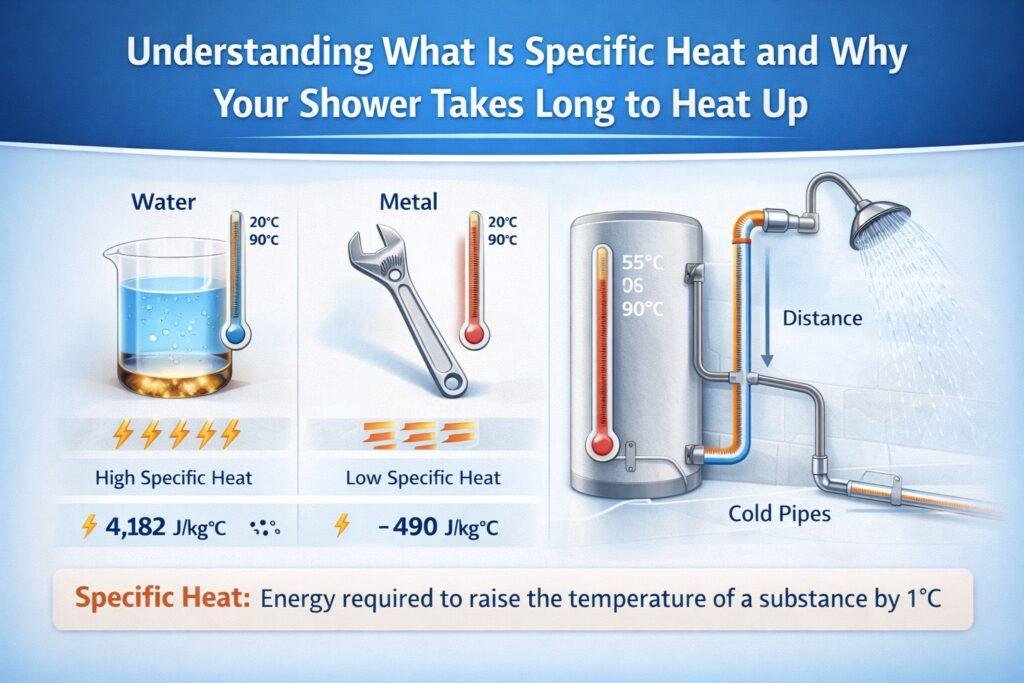
A standard 40-gallon tank provides about 12 to 15 minutes of continuous hot water for a single showerhead flowing at 2.0 gallons per minute, which indicates the expected duration of a hot shower under normal household conditions. If you leave that same tank running across two back-to-back showers without pause, the second shower turns lukewarm within 5 minutes.
Table of Contents
How long your shower water lasts
| How you use it | How often | What tells you it’s due |
|---|---|---|
| One person, quick shower | 15 to 20 minutes | Water turns cool at the end |
| Two people, back to back | 8 to 12 minutes each | Second shower loses warmth quickly |
| Multiple taps running together | 5 to 7 minutes | Temperature drops while washing dishes |
| High-flow rainfall head | 7 to 9 minutes | Spray feels tepid halfway through |
| Tankless continuous draw | Unlimited steady flow | Water never drops in temperature |
What happens if you skip it
Running hot water past your tank’s safe recovery limit drains the heated supply faster than the burner or heating elements can warm the incoming cold supply. The top layer of hot water is drawn out first, while incoming cold water enters at the bottom of the tank. Within two minutes of draining the reserve, the water mixing at your shower valve turns cool, forcing you to turn the handle fully toward hot to maintain comfort.
After months of forcing a water heater to cycle continuously through full drains, mineral scale forms faster across the internal elements or base. Hard water minerals like calcium drop out of solution when heated, settling at the tank floor where they trap heat and stress the steel lining. Over time, that heavy sediment layer prevents heat transfer into the fresh water, leaving you with shorter showers as the buildup increases until an element burns out or the tank begins to leak. You can verify your equipment’s factory heating ratings directly on the rating plate attached to the side of the heater jacket.
The signs it’s overdue
- Water turns lukewarm before the 10-minute mark on a standard 40-gallon tank, showing the heating element has lost efficiency.
- You hear rumbling or popping sounds from the utility closet during a shower, which points to steam bubbles forming beneath sediment layers.
- Water pressure drops suddenly only when using the hot side, meaning mineral deposits are clogging the outlet pipe.
- The shower stream turns rust-colored, which may indicate internal tank corrosion.
- You need to turn the shower knob further toward hot regularly, showing the thermostat sensor is failing to read the true tank temperature.
- Small drops of water pool around the base of the tank, signaling thermal fatigue has cracked the inner steel tank lining.
What it takes each time
Restoring normal shower run time usually takes about 30 to 45 minutes of maintenance and requires simple tools you already own: a standard garden hose and a flat-blade screwdriver. Draining sediment from the tank drain valve costs nothing to do yourself, but ignoring it leads directly to purchasing replacement heating elements. If mineral scale already coats the electric elements, you’ll need an element wrench and an inexpensive replacement part to swap them out. Keep in mind that this varies by model — check the label on your unit before opening any service panels.
How to go longer between times
- Install a low-flow showerhead rated at 1.5 gallons per minute, which cuts your hot water draw by 25% compared to standard heads.
- Keep your water heater thermostat set at 120 degrees Fahrenheit, following the Energy Saver water heating guidelines to reduce mineral buildup and avoid scalding.
- Stagger consecutive household showers by 20 to 30 minutes, allowing a standard 50-gallon electric tank time to heat cold replacement water.
- Flushing a few gallons of water from the bottom drain valve periodically can help remove loose sediment.
Frequently asked questions
Can a shower stay hot for 30 minutes?
Yes, but only if you use a tankless heater or a large storage tank holding at least 60 to 80 gallons of water. Standard 40-gallon household tanks run completely out of heated water well before reaching the 30-minute mark under typical residential flow rates.
Why does my hot water run out in 5 minutes?
A burned-out lower heating element in an electric water heater is the most common reason for five-minute showers. When the bottom element fails, only the top third of the tank gets hot, leaving you with a tiny fraction of your normal volume.
How long does a water heater take to recover?
About 30 to 40 minutes for a gas model, while an electric water heater needs roughly 60 to 80 minutes to reheat an entire tank from cold. Gas burners transfer heat into water much faster than standard electric immersion elements can manage.
Is it safe to set the water heater to 140 degrees?
Setting the tank to 140 degrees creates a severe scalding hazard, as water at this temperature can cause third-degree burns in seconds. While higher temperatures kill bacteria, you should keep the dial at 120 degrees unless you run an anti-scald mixing valve at the tank outlet.
What happens if you take back to back showers?
The second person receives lukewarm or cold water because the incoming cold water dilutes the remaining hot supply. If you share a home with three or more people, a tankless unit is ideal; this isn’t for small apartments where a basic tank fits your needs.
Does showerhead flow rate really matter?
Yes, switching from an older 2.5 gpm showerhead to a 1.75 gpm model extends your hot water duration by several minutes. Flow rate determines how fast hot water leaves the tank, directly controlling your overall shower time.
What to do next
Check your showerhead flow rating stamped on the spray face, then time your next shower with a watch to see if the heat holds for at least 12 minutes. If the water runs cold in under eight minutes while no other fixtures are running, check the heater jacket for active leaks, and call a licensed plumber immediately if water is pooling on the floor.
Related guides
- Clean Shower Curtain Mold With Vinegar: A Simple Guide
- Bathroom Sink Filling With Water By Itself: How to Fix It
- Bath Fitter Shower Prices: Cost and Value Comparison Guide