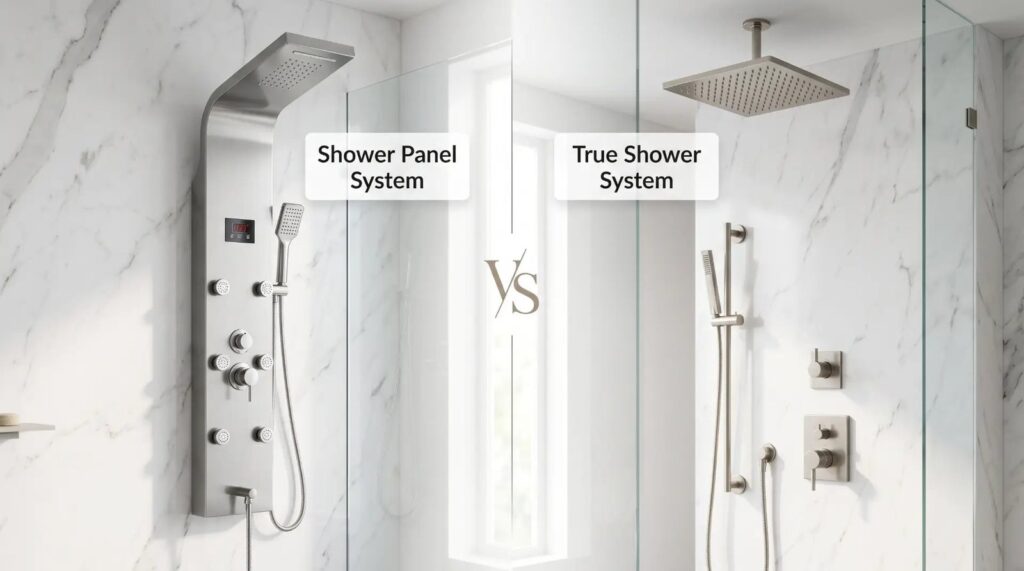
This shower panel system with body jets review shows that these units work best when your home delivers at least 40 to 45 pounds per square inch (psi) of dynamic water pressure. Getting this fixture right depends on matching your existing pipe size, hot water tank capacity, and wall rough-in dimensions before buying.
Table of Contents
How shower panel systems with body jets work

A shower tower is a surface-mounted column. It combines an overhead shower, body sprays, a handheld wand, and sometimes a tub spout. They provide a spa setup without tearing down walls.
A common myth is that the panel pumps extra pressure into your water lines. It doesn’t. Inside, standard flexible hoses split your incoming water supply to each feature. If your household pressure sits at the low end, running multiple outlets simultaneously drops the force at each nozzle.
This upgrade suits homeowners who want targeted back sprays and a rainfall head using their current hot and cold rough-in elbows. It’s a poor fit for anyone living in older apartment buildings with shared, low-volume gravity plumbing.
The basic method
Installing a panel requires basic tools and measurement. Follow these steps to hang the unit correctly:
- Turn off your home’s main water supply valve and open your shower handle to relieve remaining line pressure.
- Remove your old mixing valve trim, handle, and shower arm using an adjustable wrench and a screwdriver.
- Clean the wall surface thoroughly and attach two 1/2-inch NPT male brass adapter elbows to your existing hot and cold pipe stubs.
- Measure the height of the main users in the house, then mark your mounting bracket holes on the tile so the body sprays hit between your shoulder blades and lower back.
- Drill the marked holes into the tile using a 1/4-inch diamond-tipped masonry drill bit, keeping the drill speed slow and steady to prevent cracking.
- Insert plastic wall anchors into the holes, position the mounting brackets, and secure them firmly with stainless steel screws.
- Wrap 3 wraps of Teflon tape clockwise onto the brass adapters, hand-tighten the panel’s flexible braided stainless hoses onto them, and finish with a quarter-turn using an adjustable wrench.
- Hang the panel onto the brackets, turn the main water back on, and inspect all connections with a dry paper towel for tiny leaks before sealing the side edges with silicone caulk.
Tighten the flexible supply lines carefully. If your rough-in pipes are corroded galvanized steel, hire a plumber to install new transitions.
Key numbers and settings at a glance
Operating conditions change how well these towers perform in everyday use.
| Situation | What to use | How long | What to watch for |
|---|---|---|---|
| Standard water line (1/2-inch pipe) | 1 function at a time | 10–12 minutes | Weak jet pressure if you switch on rainfall simultaneously |
| High-flow line (3/4-inch pipe) | 2 functions at once | 8–10 minutes | Rapid drain backup if hair catches in the grate |
| Hard water supply | Silicone jet nozzles | Wipe weekly | White mineral crust building up inside nozzle tips |
| Small hot water tank (40 gallons) | Handheld wand or jets only | 6–8 minutes | Water turning cold midway through your shower |
| Large tank or tankless (50+ gallons) | Full body spray massage | 12–15 minutes | Steam buildup behind panel housing |
| Low baseline pressure (<30 psi) | Single overhead spray mode | 10 minutes | Sputtering spray patterns and uneven temperature |
What separates good results from bad ones
Preparation and knowing what to adjust are the keys to getting a satisfying shower from a panel system.
Flow checks and pipe sizing
Check your static and dynamic pressure with a gauge before hanging hardware. If static pressure is below 40 psi, you’ll need a booster pump. Experienced installers also check the inner diameter of the wall pipes. Running standard 1/2-inch lines means you should only run one feature at a time. Upgrading supply lines to 3/4-inch pipes allows you to run body sprays and the main head together without losing force.
Thermal balance and sealing
Another critical detail is hot water capacity. Body jets can drain a 40-gallon water heater in under ten minutes. When mounting the panel, leave the bottom two inches uncaulked. Seal the top and sides, but leave the bottom open to allow moisture to drain.
Common problems and quick fixes

Check these parts if your panel acts up.
| What you notice | What it usually means | What to do first |
|---|---|---|
| Water sprays in wild directions | Mineral scale blocking the rubber openings | Rub your thumb firmly across the soft silicone nozzles |
| Pressure drops sharply on all modes | Inlet debris screens are clogged with pipe rust | Detach panel and clean the wire mesh filters on supply lines |
| Water turns cold very quickly | Panel flow rate exceeds your water heater size | Run body sprays alone instead of combining with the overhead shower |
| Rattling noise inside the wall | Water hammer from quick-closing diverter valves | Check pipe strapping or add inline water hammer arrestors |
| Constant drip from lower nozzles | Internal cartridge has grit trapped inside seals | Remove the handle and flush the thermostatic cartridge with clean water |
Plumbing codes and efficiency limits
Shower fixtures sold in the United States must meet strict water conservation standards. The federal standard limits individual showerhead flow to 2.5 gallons per minute (gpm) at 80 psi. However, several states enforce lower consumption caps to protect local water supplies. According to the California Energy Commission appliance efficiency regulations, residential showerheads sold for use in California can’t exceed 1.8 gpm.
Units with independent diverters often allow you to run multiple nozzles, which can draw 3 to 4 gpm in real-world conditions if your local plumbing code permits non-restricted manifolds. Because mixing valves involve scald prevention rules under the International Plumbing Code (IPC), your installation must include an ASSE 1016 certified pressure-balancing or thermostatic valve. If your existing setup lacks proper pressure regulation, hire a licensed tradesperson to bring your rough-in plumbing up to code.
Cleaning and component care
Mineral deposits are the primary enemy of body jet panels. Rub the silicone nozzles regularly to dislodge calcium crystals. Wipe the faceplate after showering to prevent water spots. Avoid harsh cleaners, bleach, or abrasives, as these damage the finish and seals. Inspect the perimeter silicone bead whenever you notice it for gaps or peeling.
When to use a different approach
A body jet panel is the wrong choice if you rely on a small 30-gallon electric water heater or a low-yield well pump. You’ll run out of hot water before you finish rinsing, and the pump will struggle to feed multiple ports.
This hardware is also not for rental apartments where drilling into tile is prohibited. Installing the support brackets requires permanent anchor holes through your wall substrate.
A serious mistake people make is buying an oversized panel for a compact stall, costing them hundreds of dollars in wasted materials. If your shower enclosure measures under 36 by 36 inches, horizontal jets will bounce directly off your body and soak the bathroom floor outside your curtain or door. In small spaces, choose an adjustable handheld shower bar instead.
Frequently asked questions

Can you run all shower panel functions at the same time?
It depends on the diverter valve design and your household water pressure. Many basic units use a single-function diverter that only directs water to one feature at a time. Higher-end models let you run multiple outlets together, but water pressure splits between them and noticeably weakens the spray.
How high should a shower panel be mounted from the floor?
Mount the panel so the overhead rainfall head sits roughly 84 inches above the shower floor. This positioning generally places the body jets between 36 and 54 inches high, which lines up well against an average adult’s lumbar spine and upper shoulder blades.
Is dynamic water pressure different from static water pressure?
Yes. Static pressure is the force inside your pipes when all faucets are closed. Dynamic pressure is the actual pressure remaining while water flows freely out of the nozzles. A home can show 60 psi static, but drop below 30 psi dynamic once several body jets open up.
What happens if I have hard water in my home?
Hard water leaves dissolved calcium and magnesium deposits inside the internal diverter cartridges and small jet holes. Over time, this scale narrows the water channels, reduces flow volume, and causes uneven sprays. You must clean the rubber nozzles regularly to prevent permanent blockages.
Do shower panels require special electrical wiring?
No, standard shower panels run entirely on municipal water pressure and use mechanical valves. Some luxury panels feature blue LED accent lighting or digital temperature displays, but these are almost always powered by internal water-flow micro-turbines or standard AA batteries sealed in a waterproof box behind the column.
Final Thoughts
Upgrading your bathroom doesn’t have to be a headache if you plan carefully. Once you’ve verified your plumbing specs, you’ll be ready to transform your daily routine into a spa-like experience. Don’t hesitate to consult a local professional if you’re feeling unsure; they’ll help ensure everything’s installed safely for years of enjoyment.